
Roof Care
Repair or Replace a Bathroom Faucet in Boca Raton
Not sure whether to rebuild or replace your bathroom faucet in Boca Raton? Follow our step-by-step decision guide, then call a local plumber for help.
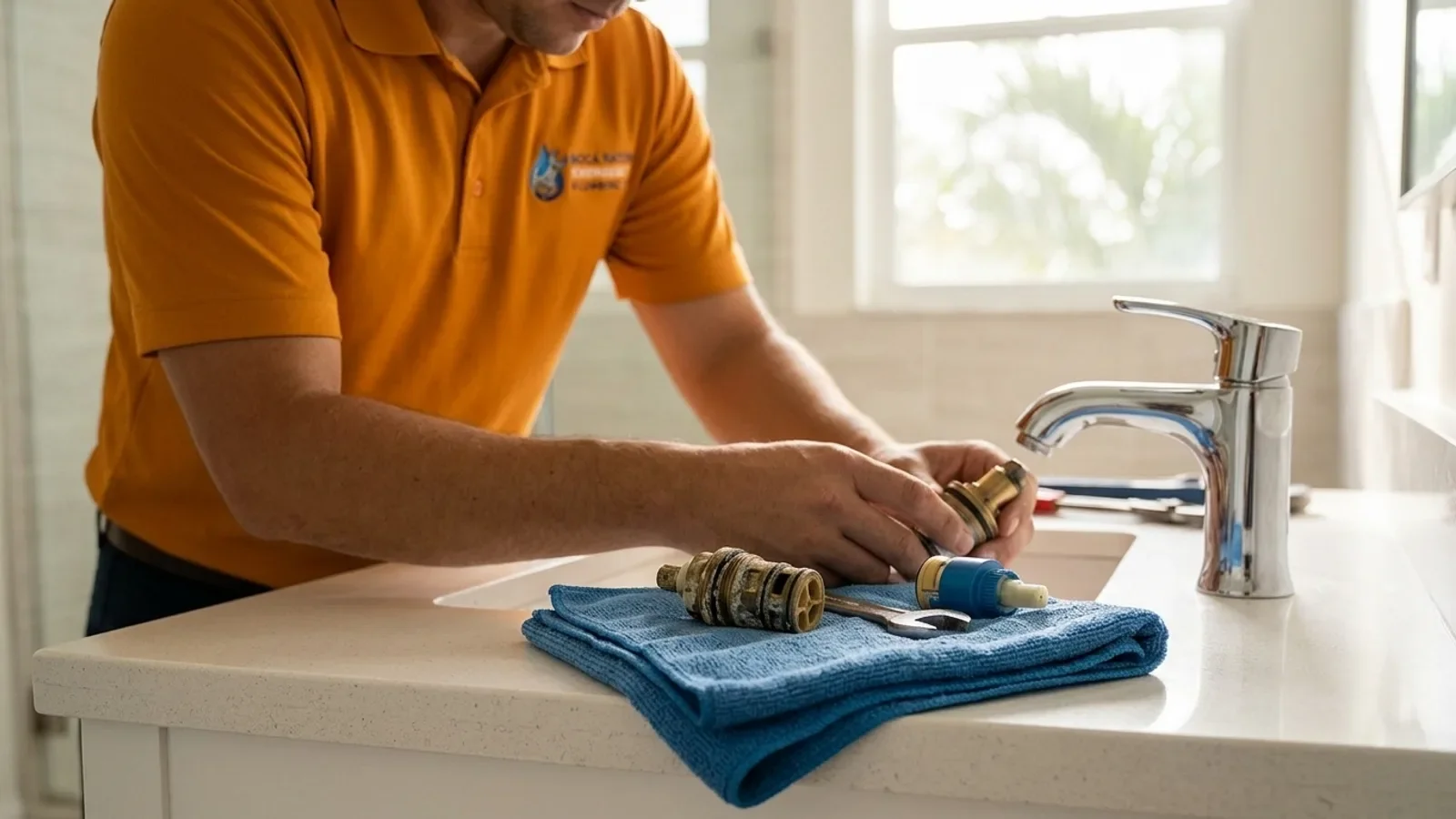
Most people think a dripping faucet means the whole fixture is finished. Usually it isn't. In Boca Raton, the real problem is often a worn cartridge or a seat caked with minerals from our hard South Florida water, and the faucet body around it is perfectly sound. Deciding whether to repair or replace a bathroom faucet in Boca Raton comes down to a handful of checks you can make in about fifteen minutes, without picking up a wrench.
This guide walks you through those checks in order. By the end you'll know whether a rebuild makes sense, whether a new fixture is the smarter move, or whether it's time to bring in a plumber. Some homes from the 1970s and 1980s still have their original vanity faucets, and plenty of newer Palm Beach County homes have mid-range fixtures already showing scale. Either way, the same logic applies.
Before you start
You don't need tools for the assessment itself. You need a clear look at the faucet and a little information about it. Gather these first:
- A flashlight to see under the sink and around the base of the spout
- A dry paper towel to check for slow seepage
- Your phone camera, to photograph the faucet, any brand markings, and the supply connections
- Any paperwork from when the faucet was installed (receipt, manual, or warranty card), if you have it
- A rough idea of the faucet's age, even a guess like "came with the house"
- A small bucket or towel in the cabinet in case you spot an active drip
One safety note. This is an inspection, not a teardown. If you find active leaking under the sink, close the fixture's shutoff valves if they turn easily and call a licensed plumber. Don't force a stuck valve. Older shutoffs in Boca homes can snap when cranked hard.
Step 1: Identify exactly where the water is coming from
Start by pinning down the symptom, because the location of a leak tells you most of what you need to know. Water dripping from the spout tip with the handle off usually points to a worn cartridge, washer, or valve seat. Water pooling around the base of the spout often means failed O-rings inside the body. Water under the sink, on the supply lines or the faucet's underside, is a different problem entirely and may involve connections rather than the faucet itself. Wipe everything dry, wait ten minutes, and check each spot with a paper towel. A drip from the spout is the most fixable case.
- Spout drip: often a cartridge or seat issue, frequently repairable
- Base leak: O-rings or a cracked body, repair possible depending on the design
- Under-sink leak: connections, supply lines, or the faucet shank
Step 2: Figure out what type of faucet you have
Look at how the handles move. A single lever that swings left and right and lifts up is usually a cartridge or ceramic-disc design. Two separate handles that turn several times before stopping are often older compression-style valves with rubber washers. Two handles that stop after a quarter turn typically have ceramic cartridges. This matters because compression valves are simple to rebuild, while some single-handle designs use proprietary cartridges that may or may not still be available. Photograph the faucet from several angles. Those pictures help a cartridge replacement plumber match parts quickly.
Step 3: Estimate the faucet's age and parts availability
Age matters less than you'd think. What matters is whether replacement internals still exist. A well-made faucet that's fifteen years old can rebuild beautifully if the cartridge is still produced. A cheaper fixture that's only five years old might use a part nobody stocks anymore. Check under the sink or on the base for a brand mark, then look for model information in any paperwork you have. If you can't identify the model at all, that isn't a dealbreaker. A plumber can often pull the cartridge and match it. It does tilt the odds slightly toward replacement, though.
Step 4: Inspect the finish and the body for corrosion
Shine your flashlight around the base of the spout, the handle joints, and the aerator. Light white crust is mineral scale, and it's usually cosmetic or cleanable. Green or bluish staining, pitting in the chrome, or flaking finish suggests corrosion working into the metal. That's harder to fix. Scale can be addressed. Corroded brass that's weakening the body generally can't. If the finish is pitted but the faucet still shuts off cleanly, you may be looking at a cosmetic decision rather than a functional one. For more on reading those deposits, see our guide to spotting hard water damage on your taps.
Step 5: Test the handles and the flow
Turn the faucet through its full range several times. Pay attention to how it feels. Smooth, even movement with a clean shutoff is a good sign. Stiffness, grinding, or a handle that has to be forced past a certain point usually means scale on the cartridge or a worn internal part, both of which a rebuild can address. Then look at the stream. A weak, sputtering, or sideways spray is often a clogged aerator or scale inside the valve, not a dead faucet. If pressure seems low at several fixtures, not just this one, the cause likely sits elsewhere in the plumbing. Our piece on why water pressure drops at Boca Raton faucets covers that side.
Step 6: Count the problems, not just the drip
Now step back and tally what you found. One issue, like a spout drip on a sound faucet with available parts, almost always favors repair. Two or three issues stacking up changes the math. A drip plus a corroded base plus a stiff handle on a faucet with no identifiable model is a strong case for a new fixture. Think about labor too. If a plumber is already pulling the cartridge, O-rings, and seat, the visit starts to look a lot like an installation anyway. That's the honest tipping point.
Step 7: Weigh what you actually want from the fixture
Function isn't the only factor. If you're planning a vanity update or you simply dislike the faucet's look, repairing it may mean paying to keep something you'll swap out soon. On the other hand, if the faucet matches a set of fixtures in the bathroom, a rebuild keeps everything consistent. Some homeowners also want features the old faucet lacks, like a higher spout or easier single-lever control. Those are good reasons to replace even when repair is possible. Be clear with yourself here. It saves a second visit later.
Step 8: Make the call and document it
Write down your conclusion along with the symptoms, faucet type, and photos. If the evidence points to a rebuild, ask for a cartridge or valve repair. If it points to a new fixture, decide on spout height, handle style, and hole configuration (single-hole or widespread) before anyone arrives. Measuring the spacing between the holes in your sink or countertop helps a lot. Going in with notes makes the conversation faster and keeps you from being steered either way. The cost side of this decision is covered in more depth in our guide to faucet repair in Boca Raton, including what drives the price of a rebuild versus a new install.
Why Boca Raton water changes the repair math
This is the local part, and it's real. South Florida's municipal water comes largely from the limestone-based Biscayne Aquifer system, which is why it carries a heavy mineral load. Calcium and magnesium settle out wherever water sits or slows down, and inside a faucet that means the cartridge, the valve seat, and the aerator. In Boca Raton, that buildup is often the single biggest reason a faucet starts dripping or sticking.
That has two consequences for the repair-or-replace decision. First, many "failing" faucets here aren't worn out at all. They're scaled up, and a new cartridge restores them. Second, a faucet that has fought hard water for many years may have scale packed so tightly into the body that a rebuild won't fully seat. Pair that with the salt air near the Intracoastal and east of Federal Highway, which can be rough on exposed finishes, and you get faucets that look tired faster than their internals warrant.
Housing age plays in too. Older condos and single-family homes from the city's big growth years often have original fixtures and original shutoff valves, both of which have endured decades of minerals. Newer construction out west tends to have fixtures that rebuild easily, as long as maintenance has been reasonable. If you'd like to slow scale down on whatever faucet you end up with, our tips on keeping mineral buildup off your taps are a good next read.
When to call a professional in Boca Raton
The assessment above is safe for any homeowner. The work that follows usually isn't a casual DIY job, especially in older homes. Call a licensed plumber when:
- Water is leaking under the sink or into the cabinet
- The shutoff valves won't turn, or you're unsure they fully close
- The faucet body or base shows corrosion, cracks, or pitting
- You can't identify the cartridge or valve type
- Removing the old faucet would mean dealing with seized or corroded mounting hardware
- You've already replaced a part and the drip came back
- Low pressure shows up at more than one fixture
Our team handles both sides of the decision. We rebuild valves and swap cartridges, and when a fixture is past saving, we install a new one. If you're leaning toward a fresh fixture, you can read more about our bathroom and kitchen faucet installation work. We're a licensed Florida plumbing contractor (CFC1433655), and we answer around the clock across Palm Beach County.
Frequently Asked Questions
Is it usually cheaper to repair a bathroom faucet than replace it?
Often, yes, when the problem is a single worn cartridge or washer and parts are available. Once several components are failing or the body is corroded, replacement can become the more sensible value.
How do I know if hard water caused my faucet to fail?
White or chalky crust at the aerator, spout, or handle base, plus stiff handle movement, are common signs of mineral scale. In Boca Raton, scale is one of the most frequent reasons we find cartridges sticking or dripping.
Can a dripping single-handle faucet be fixed without replacing it?
In many cases. A drip from the spout on a single-handle faucet usually traces to the cartridge, which a plumber can replace if a matching part is available.
Should I replace all my bathroom faucets at once?
Not necessarily. If only one is failing and the others work well, repairing or replacing just that one is reasonable, though some homeowners choose to update a set for a matching look.
Live dispatch · 24 / 7 / 365
Reading this because of an actual problem?
The phone is answered at any hour by a person who can walk you through the shut-off and get a plumber moving your way.
No obligation. Work performed under Florida plumbing contractor license CFC1433655.