
Guides
Low Water Pressure Kitchen Faucet in Boca Raton
Weak flow at your Boca Raton kitchen faucet? Use this checklist to spot clogged aerators, worn cartridges and supply issues, then call us for help.
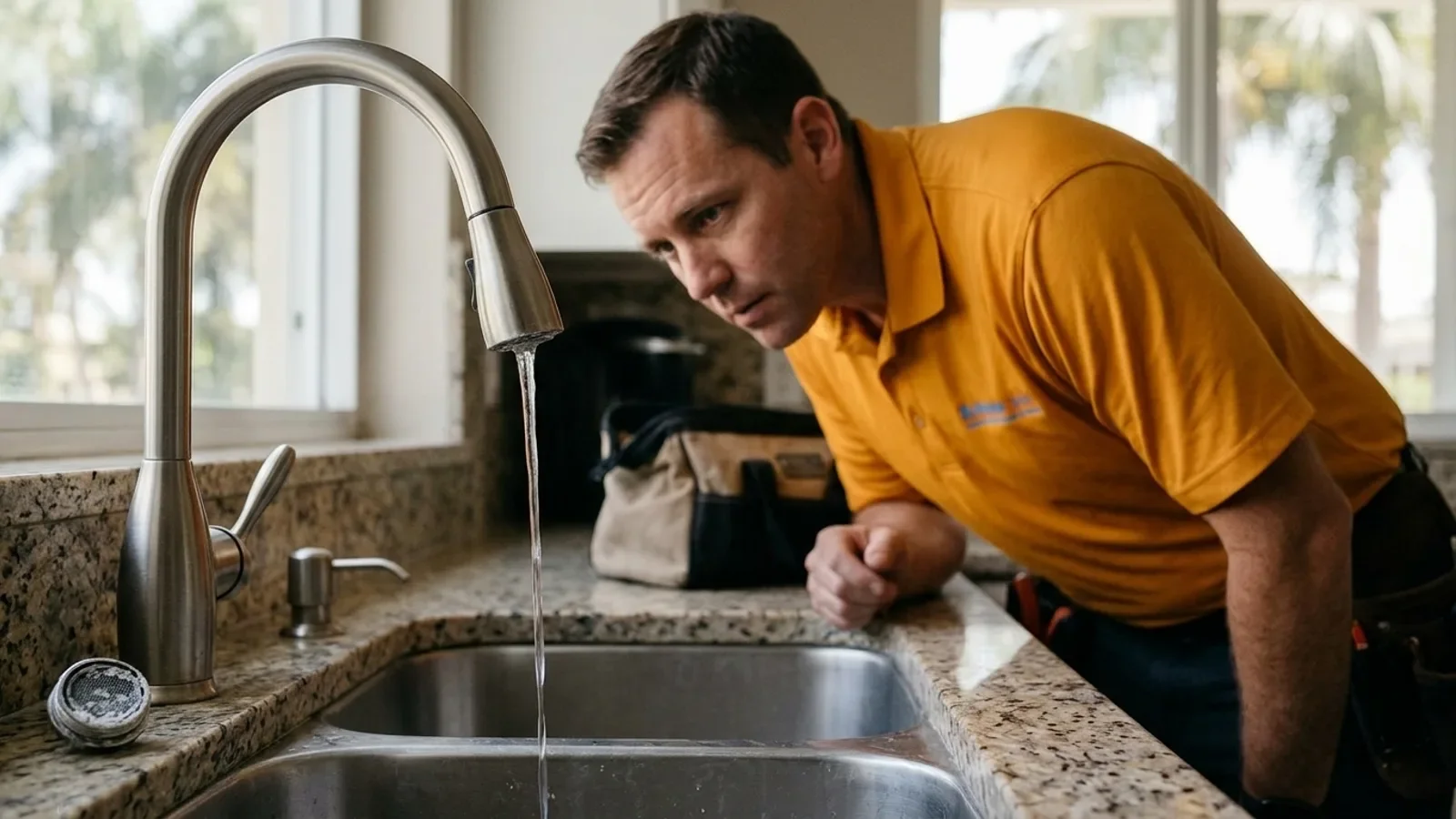
Why is your kitchen faucet suddenly running weak? Most of the time it's a clogged aerator or a worn cartridge, not a whole-house problem. In Boca Raton, hard municipal water and decades-old copper and galvanized lines make both common. Work through this checklist before you call, and you'll know what to tell your plumber.
First, figure out how big the problem is
Scope comes first. It narrows the cause fast.
- Run the kitchen faucet on full cold, then full hot, and note whether one side is weaker.
- Check the bathroom sinks and showers for the same drop in flow.
- Test an outdoor hose bib to see if pressure is low at the source.
- Ask a neighbor whether their water dropped at the same time.
- Note when the problem started: suddenly, gradually, or right after other plumbing work.
- Look for low flow at the pull-down sprayer only versus the main spout.
- Write down whether the flow sputters, surges, or stays steadily weak.
If only one faucet is weak, the culprit is almost always inside or right under that faucet. If every fixture dropped at once, the issue sits further upstream.
Check the parts you can safely reach
These steps are light homeowner maintenance. No tools beyond a soft cloth and a small bowl.
- Unscrew the aerator at the tip of the spout by hand (wrap it in a cloth to protect the finish).
- Inspect the screen for white grit, sand, or flakes of scale.
- Soak the aerator in plain white vinegar for an hour or so to loosen mineral deposits.
- Rinse the screen under running water and gently brush off any remaining buildup.
- Run the faucet without the aerator for a few seconds to see if flow returns to normal.
- Reinstall the aerator snugly by hand, without overtightening.
- Pull the sprayer head off its hose if your model allows it, and check that screen too.
- Confirm both shutoff valves under the sink are fully open (turn counterclockwise until they stop gently).
- Look under the sink for kinked or crushed supply lines behind stored cleaning products.
Strong flow with the aerator off? You found it. Cleaning or swapping the aerator usually fixes it.
Signs the cartridge or valve is the real problem
When a clean aerator doesn't help, the next suspect lives inside the faucet body. Single-handle faucets use a cartridge. Older two-handle models often use stems with washers.
- Notice whether the handle feels stiff, gritty, or harder to turn than it used to.
- Watch for flow that's weak only at certain handle positions.
- Check whether the hot and cold mix unevenly or jumps between temperatures.
- Look for drips from the spout after you shut the faucet off.
- Feel around the base of the handle for dampness or seeping water.
- Listen for a whistle or hiss when the faucet runs partway open.
- Recall whether pressure dropped right after the water was shut off and turned back on (debris often lodges in the cartridge then).
A failing cartridge often shows up as both low flow and a slow leak. That overlap is why low pressure and drips get diagnosed together. Our guide to leaky faucet repair in Boca Raton walks through how cartridges and valves wear out in local homes.
Cartridge work means taking the faucet apart. Parts are model-specific. A wrong replacement can make things worse, so this is a good point to bring in a pro.
When the cause sits beyond the faucet
Sometimes the faucet is fine. The water just isn't getting there.
- Check whether the main shutoff valve was left partly closed after recent work.
- Look for damp drywall, warm spots on tile floors, or a water bill that climbed for no reason.
- Listen for running water when every fixture in the house is off.
- Watch your water meter for movement with everything shut off.
- Note any rusty or discolored water, which can point to corroding galvanized pipe.
- Consider the pipe age if low pressure is spreading slowly to more fixtures over months.
- Leave pressure-reducing valves, gas lines, and anything inside walls or slabs to a licensed plumber.
A hidden leak steals pressure quietly. In slab-built homes it can run under the floor for a long time before anyone sees water.
Boca Raton-specific considerations
Local conditions shape why faucets lose pressure here. Keep these in mind.
- Expect faster aerator clogging, because South Florida water draws from limestone aquifers and carries noticeable calcium and magnesium.
- Inspect older faucets in homes from the 1970s and 1980s, a big share of Boca's housing, where original fixtures and supply lines are often still in place.
- Watch for galvanized steel supply pipe in some older homes, since it narrows internally as it corrodes and slowly chokes flow.
- Remember that most Boca homes sit on concrete slabs, so a pressure drop with a rising bill can mean a slab leak rather than a faucet problem.
- Check faucets after hurricane-season water shutoffs or main breaks, when sediment can get pushed into lines and lodge in aerators and cartridges.
- Run seasonal and second homes for a few minutes on arrival, because sitting water lets scale and sediment settle in fixtures over the summer.
- Ask your condo or HOA association about building-wide water work before assuming the problem is yours, especially in mid-rise buildings with shared risers.
- Confirm permit and code requirements with a licensed pro if repiping or valve replacement comes up, since requirements vary by jurisdiction.
Hard water is the thread through most of this. If you're seeing white crust on fixtures or spotty glassware, our rundown of the hard water warning signs Boca faucets show is worth a read.
Deciding what to do next
You've narrowed it down. Now pick a path.
- Clean the aerator yourself if that alone restores flow.
- Replace the aerator if the screen is corroded or bent after cleaning.
- Schedule a cartridge or valve repair if the handle is stiff, the faucet drips, or flow stays weak with the aerator off.
- Weigh replacement if the faucet is older, parts are hard to find, or the body is pitted with corrosion.
- Book a leak check if more than one fixture is weak and your bill or meter suggests water is going somewhere.
- Call for emergency help if you find active water under the sink, in walls, or on the floor.
- Keep a record of what you tested, so the plumber can skip straight to the likely cause.
Not sure whether to fix or swap? Our breakdown of repairing versus replacing a faucet covers the tradeoffs. If you want to understand the full range of failure points, start with our guide to why faucets fail in Boca Raton homes.
What a plumber typically checks
Knowing the process helps you compare quotes and ask good questions.
- Expect a flow test at the faucet with and without the aerator.
- Expect the cartridge or stems to be pulled and inspected for scale, debris, and worn seals.
- Ask whether the supply lines and shutoff valves under the sink are restricting flow.
- Ask for house pressure to be checked if several fixtures are affected.
- Request a leak check if the meter moves with fixtures off.
- Ask the plumber to explain what failed and show you the old part.
- Compare quotes by what's included: parts, labor, and any follow-up visit, rather than the headline number alone.
Our licensed team handles faucet repairs and cartridge replacements across Palm Beach County, plus leak detection and repiping when the cause runs deeper than the fixture.
Live dispatch · 24 / 7 / 365
Reading this because of an actual problem?
The phone is answered at any hour by a person who can walk you through the shut-off and get a plumber moving your way.
No obligation. Work performed under Florida plumbing contractor license CFC1433655.