
Roof Care
Hard Water Faucet Damage in Boca Raton: Warning Signs
Spot hard water faucet damage in Boca Raton early: crust, drips, stiff handles and weak flow. Learn what it means and when to call a local plumber.
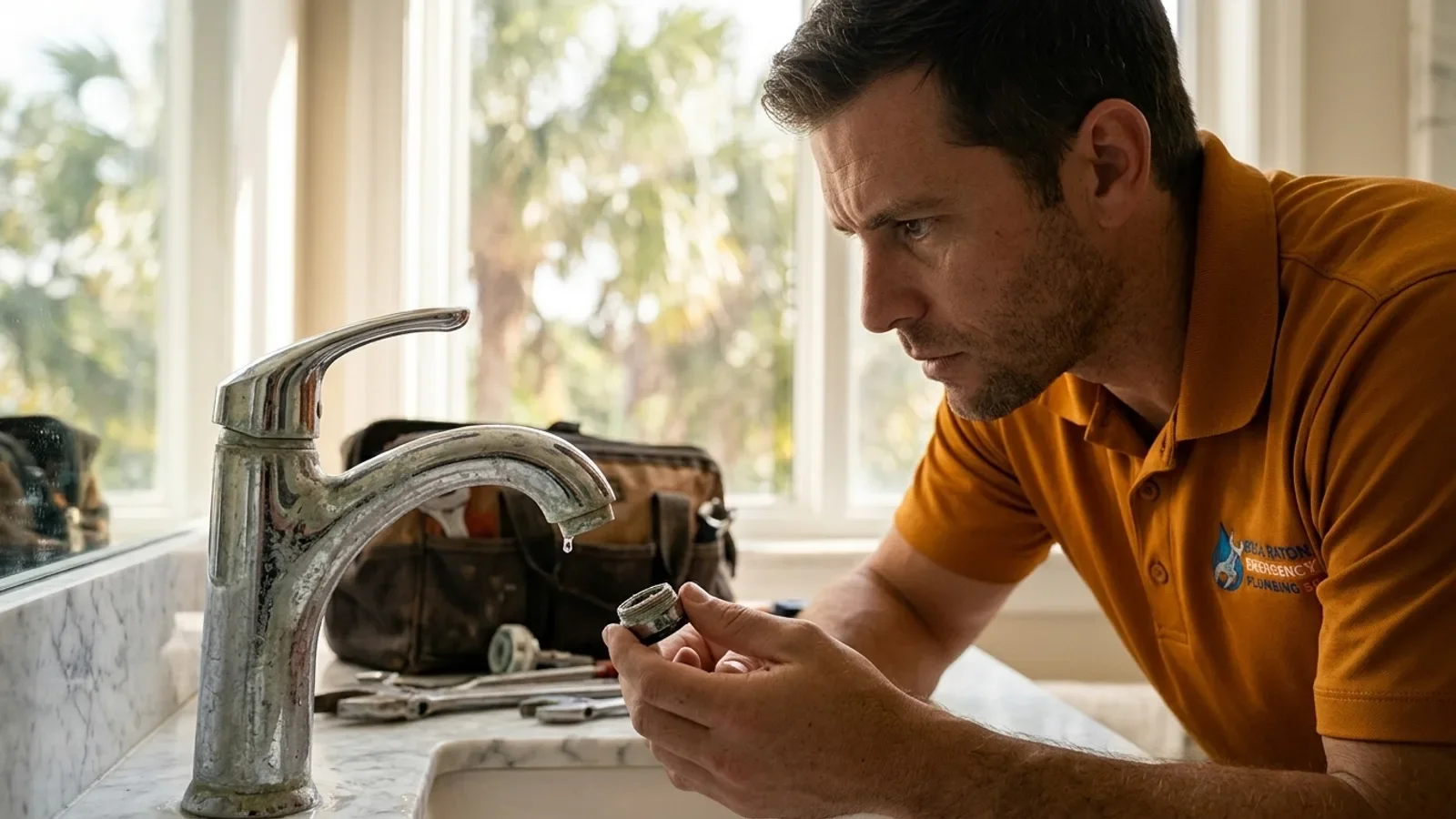
Most of South Florida's drinking water starts in the Biscayne Aquifer, a shallow layer of porous limestone that runs beneath the region. Limestone is largely calcium carbonate, so the water that passes through it picks up dissolved minerals before it ever reaches a treatment plant. Here in Boca Raton, that geology shows up in a very ordinary place: the faucet you use every morning. Hard water faucet damage in Boca Raton rarely announces itself all at once. It creeps in.
Picture it. You come back to your place off Glades Road after a few months away, turn on the kitchen tap, and it coughs. The spray is lopsided. There's a pale crust around the aerator, and the handle feels gritty when you turn it. By the next morning there's a slow drip you can hear from the living room. None of that happened overnight. It's what minerals do to metal and rubber over time, and it's one of the most common faucet calls we get across Palm Beach County.
The problem usually starts small
Hard water doesn't break a faucet in one dramatic moment. It works in layers.
The first thing most homeowners notice is cosmetic. A chalky white or faintly green ring forms where the spout meets the deck, around the base of the handles, or on the aerator screen at the tip. Wipe it and it comes back. On chrome and brushed nickel finishes, you may see spotting that no cleaner seems to fully lift.
Then function starts to slip. The stream gets narrower or sprays sideways because mineral flakes are partially blocking the aerator. A pull-down kitchen sprayer stops retracting smoothly. The single-lever handle on a bathroom faucet feels stiff, or it no longer stays where you set it.
Finally, you get the leak. A drip from the spout when the faucet is off, water pooling at the base when it's on, or a slow seep under the sink you only find when you reach for the paper towels. That's the stage where cosmetic scale has become internal wear.
Here's a quick way to read the signs, from mildest to most serious:
White or green crust outside the faucet means minerals are present and drying on the surface. Uneven or weakened flow means they're collecting in the aerator or the waterway. A stiff, grinding, or wandering handle means they're reaching the valve. A drip or base leak means a seal or cartridge has likely been compromised. If you're at that last stage, a professional faucet repair in Boca Raton is usually the cleanest way to stop the water and find out what's actually worn.
Why minerals are so hard on a faucet's insides
Every modern faucet depends on a few small parts doing precise work. Most use a cartridge or a ceramic disc valve to control flow and temperature. Those parts rely on tight tolerances, smooth surfaces, and rubber O-rings or seals that stay flexible.
Calcium and magnesium interfere with all of it.
When hard water sits inside a faucet and evaporates, or when it's heated, dissolved minerals come out of solution and harden into scale. That scale builds on the faces of ceramic discs, in the ports of a cartridge, and along the grooves where O-rings sit. Each time you move the handle, those hard deposits grind against surfaces that were designed to glide. Over months and years, that friction scores the discs and chews at the seals.
Rubber gets hit twice. Scale lodges between the O-ring and the metal it's supposed to seal against, so the seal can't seat fully. Meanwhile, the rubber itself ages, stiffens, and loses its spring. A seal that's both hardened and propped open by grit won't hold back pressurized water for long.
Hot water speeds all of this up. Minerals drop out of solution faster as water warms, which is why the hot side of a faucet, and the hot side of a cartridge, tends to scale first. It's also why the same issue often shows up at a water heater, and why a single-handle faucet's mixing valve can wear unevenly.
Corrosion adds another layer. Mineral deposits can hold moisture against brass and plated components, and where finishes are thin or already scratched, the metal underneath can pit. Once a valve seat or the inside of a spout is pitted, even a brand-new seal may struggle to stay watertight against it.
What Boca Raton homes add to the picture
The water itself is only part of the story. Boca Raton's housing stock and the way people live here shape how quickly hard water turns into a repair.
Seasonal living is the big one. A large share of Boca's condos and single-family homes, especially in the gated communities west of I-95 and the towers along A1A, sit empty for part of the year. Water left standing in a faucet's body and supply lines for months has plenty of time to deposit minerals and dry out seals. Late fall, when part-time residents return, is when we hear the most about faucets that worked fine in spring and now drip, stick, or sputter.
Building age matters too. Much of the city was built out from the 1970s through the 1990s. Plenty of those homes still have original or second-generation fixtures, older shutoff valves under the sinks, and supply lines that have been in service for decades. A worn faucet is often surrounded by other aging parts, and stiff or crusted shutoff valves can complicate what should be a simple repair.
Then there's the coast. Homes near the Intracoastal and the beach deal with salty, humid air that's tough on exterior finishes and, over time, on plated metal anywhere moisture lingers. Combine that with hard water inside the fixture and finishes can deteriorate faster than owners expect.
Finally, many Boca homes have higher-end fixtures with ceramic valves and specialty finishes. Those faucets are built to last. They're also less forgiving of grit, and their parts are specific to the model, which makes correct identification important when something wears out.
How hard water faucet damage gets properly fixed
There's a temptation to treat a mineral-damaged faucet with a scrub and a vinegar soak. On the outside, that's reasonable. Cleaning an aerator screen or wiping scale off a spout is safe, simple homeowner maintenance. Inside the valve, it's a different job.
When we come out for a faucet that's dripping or binding from scale, the work usually follows a straightforward path.
First, we shut off the water at the fixture and confirm the shutoff valves themselves still close. In older Boca homes, that step alone can turn up a stuck or weeping valve that needs attention.
Next, we take the faucet apart and look at what's actually worn. Sometimes it's only an O-ring or a seat and spring. Sometimes the cartridge or ceramic disc assembly is scored and needs to be replaced. We match replacement parts to the faucet's make and model so the new components seat correctly.
We clean scale out of the valve body and waterways while it's open, because dropping a new cartridge into a crusted housing just starts the wear cycle over. We check the spout, the sprayer hose on kitchen faucets, and the supply connections under the sink, since a leak at the base sometimes isn't the faucet at all.
Then we reassemble, restore water, and test hot and cold through the full range of the handle. The goal is a faucet that shuts off cleanly, holds its temperature setting, and doesn't weep anywhere.
Not every faucet is worth rebuilding. If the body is cracked or badly pitted, if parts for an older model are no longer practical to find, or if several components are failing at once, replacement can make more sense. We'll talk through that honestly. If you're weighing the two, our guide on deciding whether to repair or replace a worn faucet walks through the factors we look at. When a new fixture is the better call, we handle the swap too, and you can read more about how a licensed plumber handles faucet repair and installation for local homes.
When the faucet isn't the only thing scaling up
A crusted faucet is a clue. It tells you minerals are moving through your plumbing, and they don't only settle at the tap.
Weak flow at one faucet is usually an aerator or cartridge issue. Weak flow at several fixtures can point somewhere else, such as scale in a water heater, restrictions in older pipe, or a supply problem. That's a different diagnosis, and it's worth reading up on what causes low water pressure across a Boca home before assuming every tap needs work.
Water heaters are worth a mention here. Tank units collect sediment from hard water over time, and that sediment can affect performance. If you notice popping or rumbling sounds from the tank, or hot water that runs out sooner than it used to, that's a separate repair we handle, and it's often worth checking at the same visit.
Leaks are the other concern. A dripping faucet is visible. A slow seep from a corroded supply line inside a vanity cabinet isn't, and it can quietly damage cabinetry and flooring. When we're under a sink for a faucet job, we look at what's around it. That's simply good practice.
What to expect after the repair
Once a worn cartridge or set of seals is replaced and the valve body is cleaned, most faucets feel noticeably better. The handle moves smoothly. The drip stops. The stream comes out straight again.
The water, though, stays the same.
The minerals that caused the problem are still coming in from the aquifer, so scale will start forming again. The difference is that you're starting from clean parts instead of worn ones, and a little upkeep goes a long way. Wiping faucets dry after use, soaking aerators now and then, and running taps periodically in a home that sits empty all help slow the buildup. We cover those habits in more detail in our post on keeping mineral buildup off Boca Raton taps.
If you're a seasonal resident, it helps to have someone run the faucets while you're away, or to plan a quick check when you return. Catching a stiff handle early is far easier than chasing a leak later.
And if a faucet starts dripping again after a repair, don't ignore it. Sometimes another seal on the same fixture was close to failing. Sometimes the issue is downstream. Either way, it's worth a look sooner rather than later, and our team can schedule a faucet repair visit anywhere in Boca Raton when it suits you.
Frequently Asked Questions
Is the white crust on my faucet a sign of hard water damage?
White or greenish crust is mineral scale left behind as hard water evaporates. On its own it's mostly cosmetic, but if you also notice a stiff handle, uneven flow, or a drip, the minerals have likely reached the valve and seals inside.
Can I just clean scale out of my faucet myself?
Cleaning the aerator and wiping scale from the outside of the faucet is safe, simple maintenance. Once a faucet is leaking or the handle is binding, the cartridge or seals are usually worn, and a plumber can take it apart, replace the right parts, and clean the valve body properly.
Why does my Boca Raton faucet leak after I've been away for months?
Water left standing in a faucet while a home sits empty has time to deposit minerals and dry out rubber seals. When the faucet is used again, those stiffened or grit-propped seals may not close fully, which is why drips are common when seasonal residents return.
Does a dripping faucet mean I need a new one?
Not always. Many drips are fixed by replacing a cartridge, O-ring, or seat, but a cracked or heavily pitted faucet body, or several failing parts at once, can make replacement the more practical choice.
Live dispatch · 24 / 7 / 365
Reading this because of an actual problem?
The phone is answered at any hour by a person who can walk you through the shut-off and get a plumber moving your way.
No obligation. Work performed under Florida plumbing contractor license CFC1433655.