
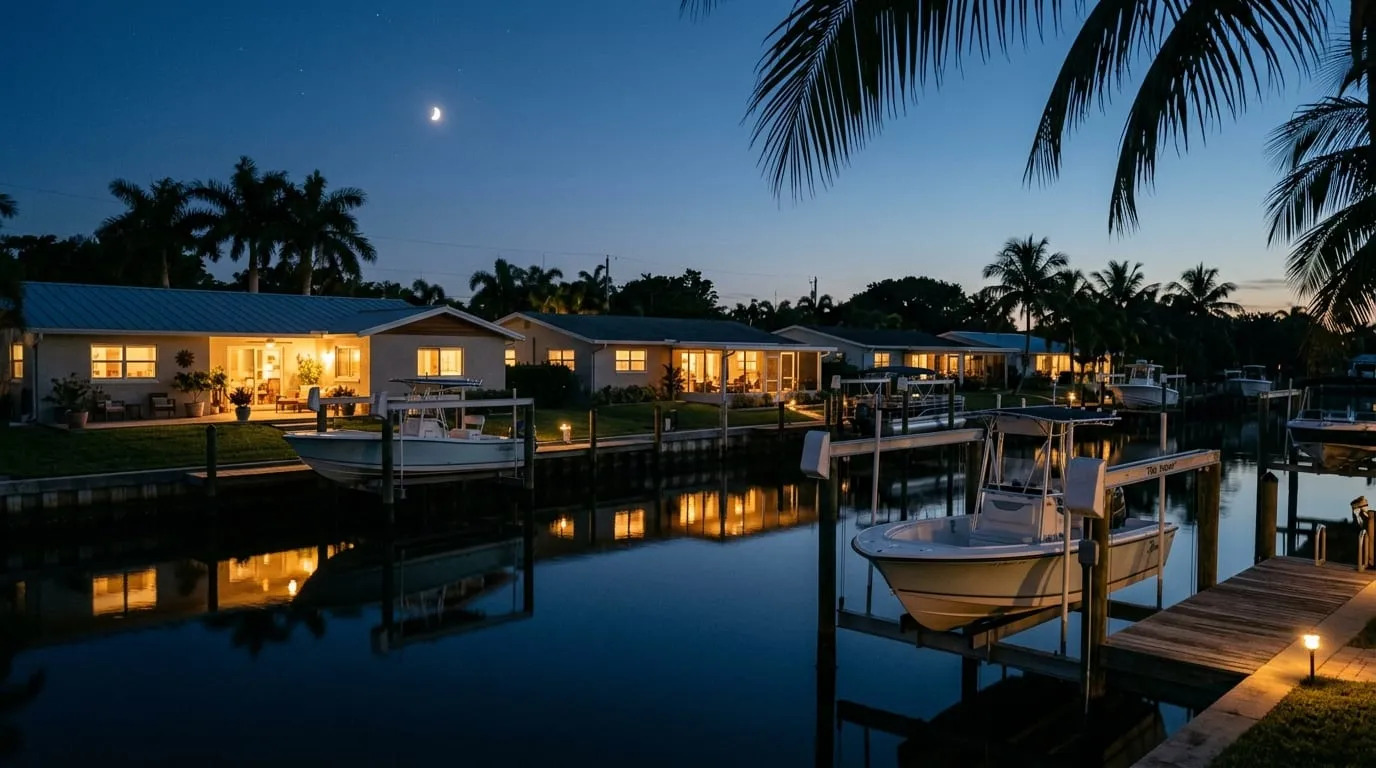
Storm season runs June through November
The plumbing checklist worth finishing months before storm season starts
Most storm-season plumbing failures start as a groundwater problem, not a wind problem, and the fixes that prevent them work only if finished in the dry months.
Nearly every storm-related plumbing failure is really groundwater finding its way somewhere it should not. That is fixable in the dry months and close to unfixable once the rain starts, when every contractor across three counties is already booked solid.
What actually causes plumbing problems during a Florida storm season?
Wind is rarely the cause. The failures that repeat every season start with groundwater. Heavy rain lifts an already shallow water table, that water works its way into the sanitary sewer through cracked pipe, bad connections and open manholes, and the system ends up carrying more than it was ever built to handle. Once capacity is gone, the overflow comes out at whichever opening sits lowest.
That explains why a house with no drainage history suddenly has one mid-storm, and why the water tends to appear in a ground-floor shower or floor drain rather than at whatever fixture someone was actually using.
The same rising water disables everything else at once. A septic drainfield has nowhere left to disperse into. A well pump stops the instant the power does. A sump pump learns it has not run in a year exactly when it is finally needed.
Two lists, two timelines
What to handle months ahead, and what to handle in the final days
Split into two timelines on purpose. The first needs a dry month and sometimes a contractor’s schedule. The second is what can still be done in an afternoon once a storm is already in the forecast.
Before the season
- Get an aging sewer lateral scoped with a camera. Groundwater gets into the sanitary system mainly through cracks and failed joints in exactly this kind of line, so a lateral that is already weak heading into spring is the one that gives out once the rain starts. Anyone who has had a storm backup before should put this first.
- Exercise the main shut-off valve. Close it, confirm every tap runs dry, then reopen it. Valves left untouched for years can seize solid, and the middle of an emergency is the worst possible moment to learn that one has. A separate article on this site covers finding it.
- Pump the septic tank if it is due. Local tanks generally need pumping every two to three years, a shorter cycle than the three-to-five-year window used as a national rule of thumb, because sandy ground, a high water table and heavy seasonal rain accelerate what a drainfield can absorb. A larger household can shorten that cycle even further. The benefit only materializes if the work happens before the season, not after.
- Test the sump pump, if the property has one. Send water into the pit and confirm it starts, lifts, and shuts off cleanly on its own. Trace the discharge line to where it actually empties, and make sure that spot will not itself be underwater when the pump needs it most.
- Assess the water heater’s surroundings. This matters most for units sitting in a garage or anywhere low-lying. A tank that has sat in floodwater does not simply get switched back on, so learning its feed line and isolation point ahead of time saves real trouble later.
- Keep the exterior drainage clear. That means yard inlets, area drains, and whatever gutters and downspouts feed into them. None of it is plumbing in the strict sense, but it is frequently the deciding factor in whether water reaches the building at all.
- Work out a power plan if the property runs on a well. A well with no electricity delivers nothing, which puts it in a completely different category from a city connection that keeps flowing through an outage. Decide beforehand how the household will handle drinking water and sanitation if that happens.
In the final days before a storm
- Store water for washing and flushing. Keep it apart from drinking supply. A tub filled ahead of time is what lets a toilet keep functioning once pressure or supply drops away.
- Skip the laundry, the dishwasher and long showers while conditions are worst. Adding load to a sanitary system that is already stretched thin raises the odds of the backup happening inside your own walls, and this is the one variable actually within a household’s control mid-storm.
- Make sure more than one person in the house can find the main shut-off. Whether a line fails while the house sits empty or the supply returns with a pressure spike, that valve is the first thing anyone will need.
If it backs up anyway
Stop using water in the building right away. Anything sent down adds to what is already pushing back up. Keep everyone away from the water itself, since a sanitary backup is contaminated no matter how it looks. Photograph the damage before any cleanup starts, since that is the record an insurer will want. And report it: if the surcharge originated in the public system rather than in the property’s own lateral, the utility needs to know, and it changes where responsibility actually lies.
Why this belongs in the spring, not the fall
Two reasons, and the second gets underestimated. The obvious one: the work is physically impossible once the ground is saturated, since nobody can pump a tank into a flooded drainfield or properly inspect a lateral sitting underwater. The less obvious one is availability. Once a storm has passed, every plumber, restoration company and equipment supplier across three counties is booked at the same time, and the wait stretches into weeks. Preventive work runs on a schedule; storm work runs on a waiting list.
Questions
Questions people ask about plumbing before a storm
Why does a shower back up whenever it rains heavily?
Rain and groundwater work into the sanitary sewer wherever pipe has cracked or a connection has failed, and once the system exceeds what it can carry, the overflow surfaces at the lowest point it can reach. In a great many houses, that point is a ground-floor shower or a floor drain.
Is it worth shutting off the water before a storm?
It is a sensible precaution when the property will be empty, since it removes the risk of an unattended supply failure. If the water is shut off, open it slowly on return, since opening it fast sends a pressure surge through the entire system.
Would a backwater valve solve this for good?
It is built specifically for this failure, though whether one makes sense for a given property depends on drainage layout and on what local code allows. Raise it as a project for the dry season. It is something installed ahead of time, not something fixed in the middle of a storm.
A septic tank is due for pumping but the season has already started. Is it better to wait it out?
Do not hold off. Going into a wet stretch with a tank that is already overdue raises the odds it fails once the surrounding ground saturates, which is the exact reasoning behind the shorter local pumping schedule in the first place.
The water came back discolored after the storm passed. Is that a problem?
Cloudy water right after service resumes is ordinary, usually just sediment stirred loose by the pressure swings. The thing actually worth checking is whether the utility has put out a boil notice or similar advisory; let that guide the response instead of the water’s appearance.
Can a well pump run off a generator during an outage?
It is common practice, though the details are what matter: a pump draws far more current at startup than while running, and wiring it in has to be done by someone who can do it safely rather than as an improvised workaround. Work out the pump’s actual requirements before the season arrives, not during it.
Live dispatch · 24 / 7 / 365
Reading this because of an actual problem?
The phone is answered at any hour by a person who can walk you through the shut-off and get a plumber moving your way.
No obligation. Work performed under Florida plumbing contractor license CFC1433655.