
Answered any hour · fixed when that is the honest call
Getting a straight answer on whether your water heater is worth repairing
The problem gets sorted into three buckets: the tank itself, its controls, or the system feeding it, because two of those are usually a repair and the third one almost never is.
Is a broken water heater usually repairable, or does it need replacing?
That depends entirely on which part actually failed. A thermostat, a heating element, a gas control valve, a thermocouple or an anode rod are all repair items, and on a tank that still has useful life left, fixing the part is the right move. A failed control does not mean the heater itself has failed.
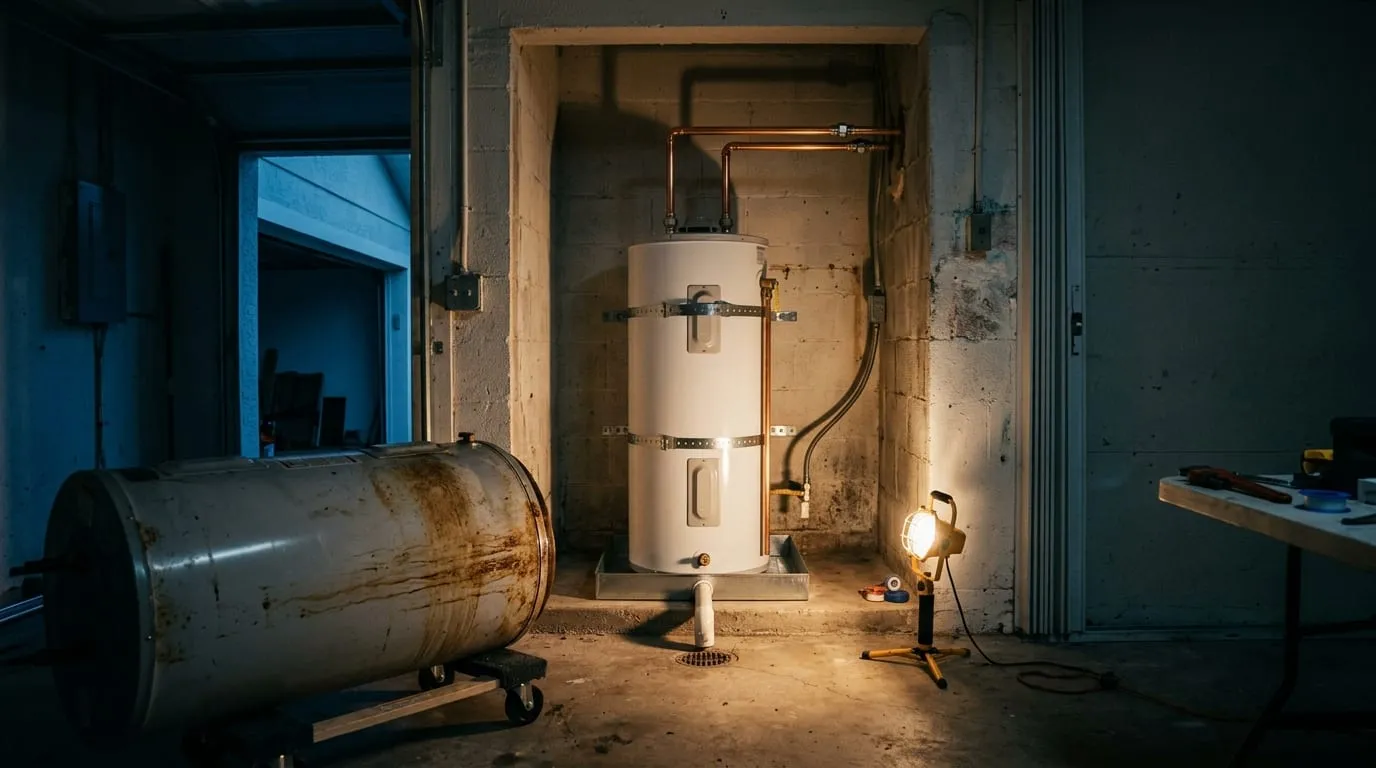
The tank shell is the one exception. Once the steel itself has corroded through, no part fixes that, and water coming from the body of the tank rather than a fitting or connection is the clearest sign the job in front of you is a replacement, not a repair.
Then there’s a third pattern that gets misread more than any other. A weeping relief valve usually isn’t a failing part so much as thermal expansion working through a closed system with nowhere else to send that pressure, and the actual fix is an expansion tank, not a new valve. Swap the valve alone and it usually starts weeping again.
Reading the symptom
What each complaint is usually pointing at
More than one of these has a cheaper cause than most people assume.
Water that gets warm but never hot
Most often a thermostat is to blame, or, if the tank is electric, one of its pair of heating elements. Lose just one element and you get a tank that warms the water without ever finishing the job.
A relief valve that keeps dripping
Often thermal expansion inside a closed system rather than a failed part. The right fix is an expansion tank, sized with at least a two-gallon acceptance volume for a closed system, not a replacement valve.
Water pooling at the base of the tank
Worth tracing before assuming the worst. A loose fitting, relief-valve discharge, or simple condensation are all repairable. Water seeping from the tank’s body itself is a different story.
Hot water that doesn’t last like it used to
Usually sediment taking up space at the bottom of the tank. Local water leaves mineral deposits behind, and that costs the tank its capacity long before it costs the tank its life, which is why a flush is sometimes genuinely the fix.
Rumbling or popping sounds while it heats
Water trapped underneath a layer of sediment, boiling its way through. Same root cause as the lost capacity above, and the same first thing to try.
Questions
What people ask before booking a repair
My relief valve is dripping. Is that a hazard?
A drip there means the valve is doing its job. The real question is what is forcing it to open. Nine times out of ten the culprit is a closed system with nowhere for expanded water to go, and the actual solution is adding an expansion tank rather than swapping in a new valve. Whatever the cause turns out to be, that valve should never get capped or ignored.
Is it worth fixing a tank that is out of warranty?
Often, and it comes down to which part failed. Swapping a thermostat on a ten-year-old unit that still has some life left is money well spent. That same swap on a tank already losing capacity to sediment and weeping from a fitting just delays a decision you will be making again soon, and that gets said plainly, not upsold around.
Does fixing a water heater require a permit?
A repair usually does not; a full replacement almost always does. Most Florida jurisdictions require a permit and inspection for a water heater replacement, since it touches venting, pressure relief, gas or electrical safety, and energy code compliance.
Would flushing the tank actually help?
If the complaint is reduced hot water capacity or rumbling noise, often yes, since both usually trace back to sediment rather than a failing heater. It is also the least expensive thing to try first, and even a flush that doesn’t solve it tells you something useful rather than wasting the visit.
Related work
What a water heater visit often turns into next
Repair and replacement stay on two separate pages for a reason.
Live dispatch · 24 / 7 / 365
Stuck with cold water, or a tank leaking where it shouldn’t?
Whoever picks up, any hour of the day, starts by figuring out whether a part gave out or the tank itself did. Fixing one is routine, fixing the other means a new heater.
No obligation. Work performed under Florida plumbing contractor license CFC1433655.