
Answered at every hour · footage is yours to keep
Camera inspection for South Florida drains, run from Boca Raton
The camera travels the full run from an access point, and the recording plays on a screen you can watch, so a repair scope gets set by what the lens actually found rather than by a guess.
What does a sewer camera inspection actually find?
It finds the four facts a repair quote depends on: what material the pipe is, exactly where a defect sits, how long the damaged stretch actually is, and whether everything else along that run is still holding up. Skip that step and a scope is a guess wearing a price tag, usually set to cover the worst case rather than the real one.
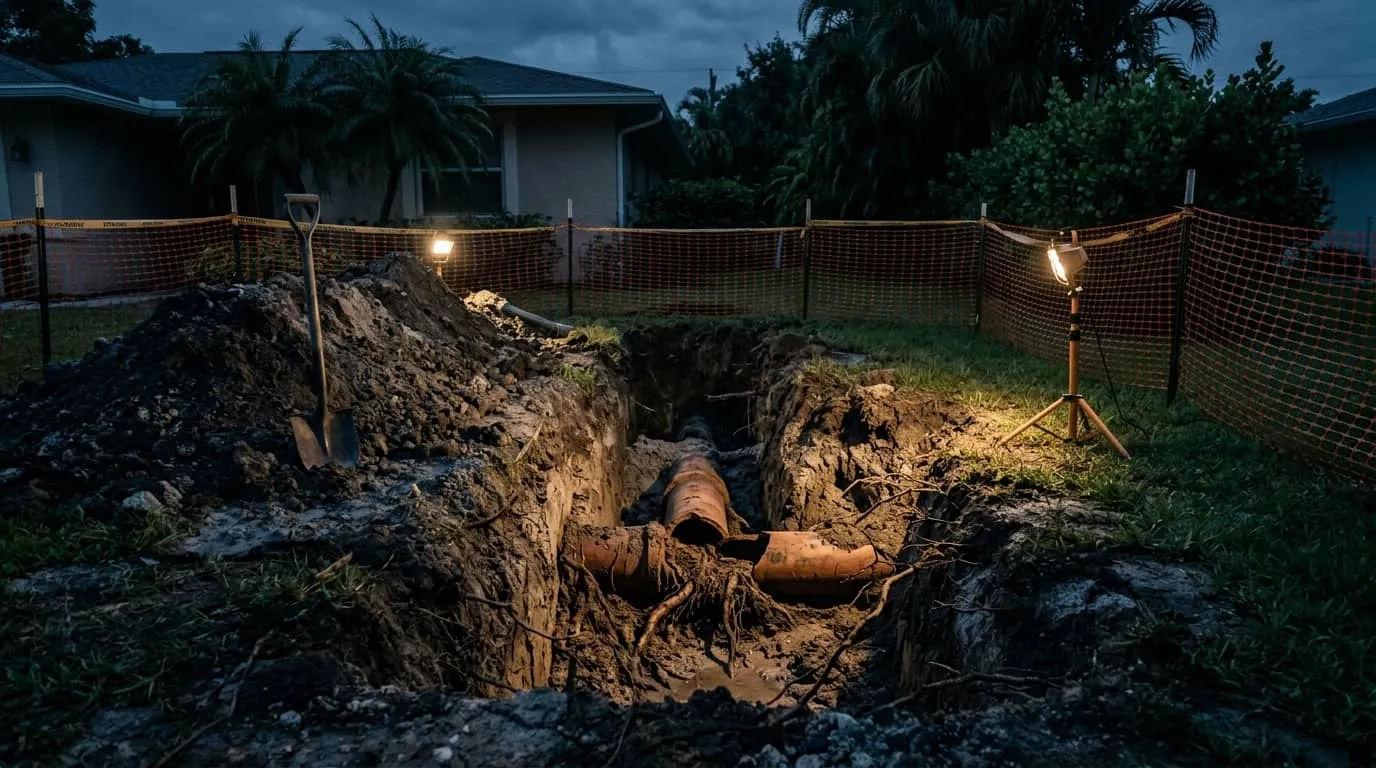
Across South Florida that question almost always comes down to cast iron. Homes built roughly from 1945 through 1975 carry cast iron drains, and only a camera separates a section that has truly failed from one that is merely scaled, two very different jobs, and the gap between them is usually where the cost lives.
Footage also settles who is responsible. Where a defect sits relative to the property line decides whether the fix belongs to the homeowner or the utility, and that is worth knowing before any ground gets opened near it.
When to run one
The calls where a camera changes the outcome
Not every clog needs a lens run through it. These situations do.
The same clog, back for a third time
Two clearings inside a year is the line describing its own condition, not bad luck. Paying for a third one without asking why is an expensive way to keep not knowing.
Before signing off on a full line replacement
Scope is where the price comes from. Footage turns a proposed number of feet into a length anyone can check against the recording afterward.
Before closing on an older South Florida home
In a house from the cast iron years, the drain line is one of the only major systems a standard home inspection never actually reaches, and one of the costliest to misjudge.
Before concrete gets opened
Cutting a slab cannot be undone. Knowing exactly where the failure sits and how far it runs first turns a short camera visit into real savings on the cut itself.
When it isn’t clear whose pipe it is
Near a property line, a few feet decide whether a repair lands on the homeowner’s bill or the utility’s. That’s a measurement a camera can make, not an argument anyone needs to have.
How the visit runs
From cleanout to a decision you can watch
Three steps, ending with a recording that stays with you.
- 01
Locate or create an access point
An existing cleanout usually does the job. Where a property has none, that gap is itself worth noting. Some South Florida jurisdictions place that responsibility on the owner, and putting one in is what makes the far side of the line reachable at all.
- 02
Run the camera and mark what it finds
The lens travels the entire run, and any defect gets pinpointed from the surface, so a crew can dig once, in the right spot, instead of hunting for it.
- 03
Review the footage together
You watch the same recording the recommendation is built on, frame included. Finding a healthy pipe counts as a good result here, not a wasted trip.
Questions we hear
What people ask before booking a camera
Do I actually get a copy of the footage?
Yes, and any company worth hiring should hand it over without being asked twice. A recommendation backed by video is something a second opinion can check against; one without it is just somebody’s word.
Will a sewer camera find a leak in my water line?
No. A drain camera travels through open pipe, and a supply line is sealed and pressurized, a completely different kind of problem. Finding that leak takes acoustic listening, thermal imaging or a pressure test, not a lens.
What happens if my house has no cleanout at all?
Access comes through a fixture, a pulled toilet, or a new cleanout gets installed first. Worth knowing either way: in parts of Miami-Dade, installing a property-line cleanout falls to the owner, and that fitting is what opens access to the county’s own section of pipe.
Can footage tell me if lining is possible instead of digging?
It’s the only reliable way to answer that question. A liner needs a clear path to travel through, so a cracked or root-intruded pipe is often a candidate while a collapsed or badly offset one usually isn’t. That call gets made from what the recording actually shows.
Where this leads
The decision a camera inspection sets up
Footage is what makes the choice between these an informed one.
- Cast iron replacementfor a section the footage shows is genuinely gone
- Trenchless sewer repairwhen a liner still has a clear path to travel
- Hydro jettingwhen the pipe is fine and only the wall needs clearing
- Sewer line repairwhen the trouble sits out at the lateral
- All servicesnineteen more, from leak detection to septic
Live dispatch · 24 / 7 / 365
Already have a quote for a drain repair?
Someone picks up at any hour, from Boca Raton. Run a camera first and the scope stops being a promise you take on faith.
No obligation. Work performed under Florida plumbing contractor license CFC1433655.