
Answered day and night · stops and supply lines included
A faucet repair that starts by testing the valve beneath it
A faucet is only one piece of a small assembly that includes its supply lines and the angle stops beneath it, and the cheapest parts in that assembly are usually the first ones to give out.
Why does fixing a dripping faucet sometimes turn into a bigger visit?
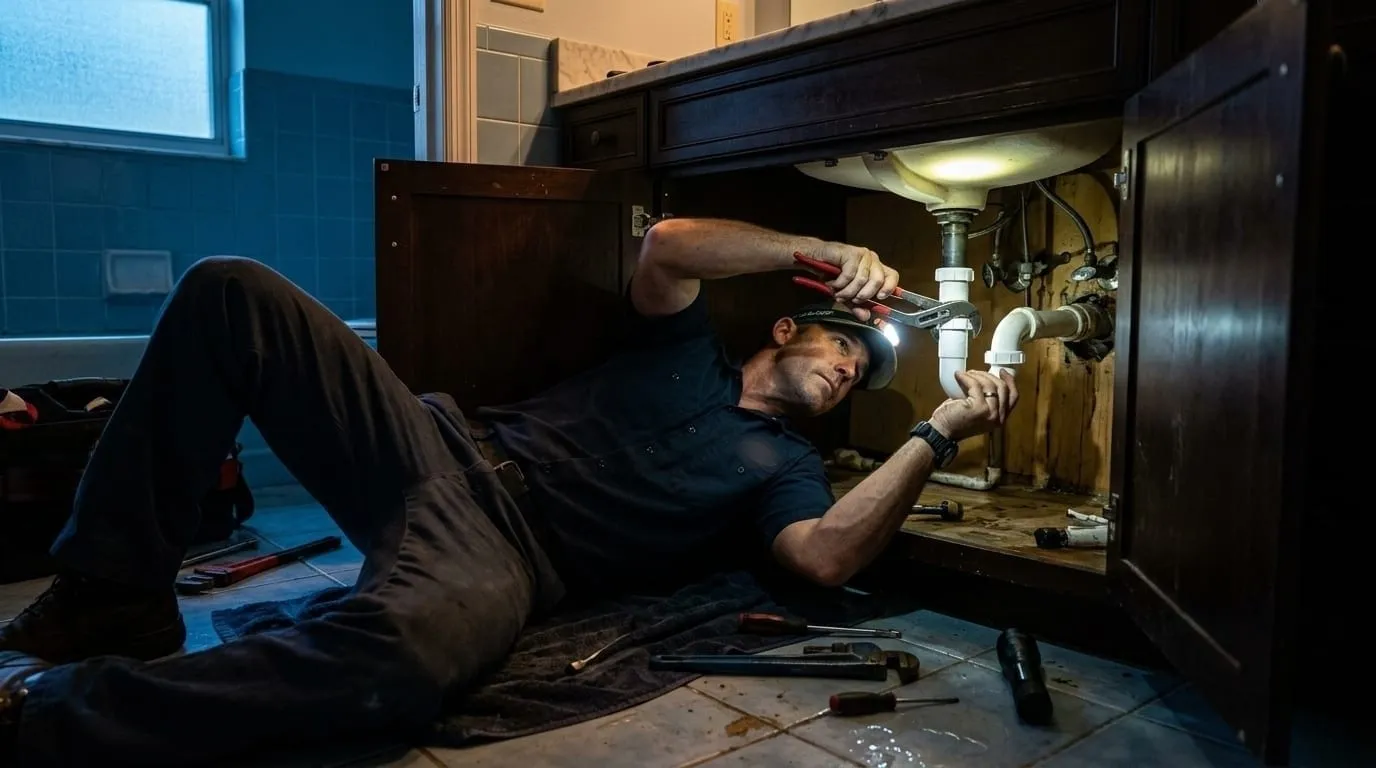
The sink cabinet holds the real answer. Before any faucet can be worked on, it has to be isolated at its angle stops, and stops that have sat untouched for two decades have a habit of seizing solid or weeping the moment they are turned back on. When that happens, the fix in front of you suddenly needs the main shut off for the whole house and both stops swapped out first, purely so the actual faucet repair has somewhere to start.
None of that argues against making the repair. It only means the conversation should be expected, because this exact scenario is the most ordinary way a simple fixture visit stretches into a longer one.
Worth checking at the same time: the braided supply line feeding the faucet. It has a service life, it is the cheapest part of the assembly, and when it finally fails, it does so at full pressure inside a cabinet.
What you are seeing
What each symptom is actually pointing at
Most of these trace back to a cartridge, a seal or an aerator, not the faucet body itself.
A drip that never quite stops
Usually a worn cartridge or seat behind it. On most modern faucets that is a straightforward repair, and the part itself costs a small fraction of a new fixture.
Weak flow, but only from one tap
Mineral buildup from regional water tends to collect in the aerator before it collects anywhere else in the fixture, which makes it both the cheapest thing to check and the one most often skipped.
Water pooling at the base, or under the cabinet
The faucet itself is rarely the source. Look instead at the supply connection, the angle stop, or a braided line that has finally given out, and treat this one as worth acting on the same day.
A handle that has gone stiff, or will not stay put
Cartridge wear again, usually. It shows up more often in hard water, and in most cases it is a repair rather than a reason to replace the whole faucet.
A shut-off valve that refuses to turn
Worth knowing before it matters. A stop that cannot close is the reason one small leak turns into shutting off water to the entire house while someone tracks down the main.
Questions
Straight answers before you call
Should a faucet be repaired, or replaced outright?
Repaired, in most cases. Cartridges, seats and aerators are all serviceable, and the parts involved are a small fraction of the cost of a new fixture. Replacement starts to make sense once the body itself has corroded, or once parts for that particular model are genuinely no longer made.
Why would the valves under the sink need replacing too?
Because if they will not close fully, the faucet cannot be isolated, and the repair cannot go ahead without shutting off water to the whole house. That is common in older houses, and it is far better to hear it at the start of a visit than partway through one.
Is it worth replacing braided supply lines before they fail?
They are the cheapest part of the whole assembly, and they tend to fail at full pressure inside a cabinet rather than giving much warning first. If they are already exposed for other work, replacing them at the same time is the small decision that avoids a much larger one later.
The water is weak at just one tap. Is that a pipe issue?
Almost never. One weak tap points at that tap specifically, usually the aerator and occasionally the cartridge behind it. If every tap in the house is weak at once, that is an entirely different question, and it has more to do with the supply than with any single fixture.
Related work
Other jobs that turn up in the same cabinet
A faucet visit rarely stays confined to the faucet.
Live dispatch · 24 / 7 / 365
Still dripping, or is water pooling under the cabinet?
Someone picks up the phone at any hour, day or night. Water pooling under the cabinet is the one to call in today rather than let sit until the weekend.
No obligation. Work performed under Florida plumbing contractor license CFC1433655.