
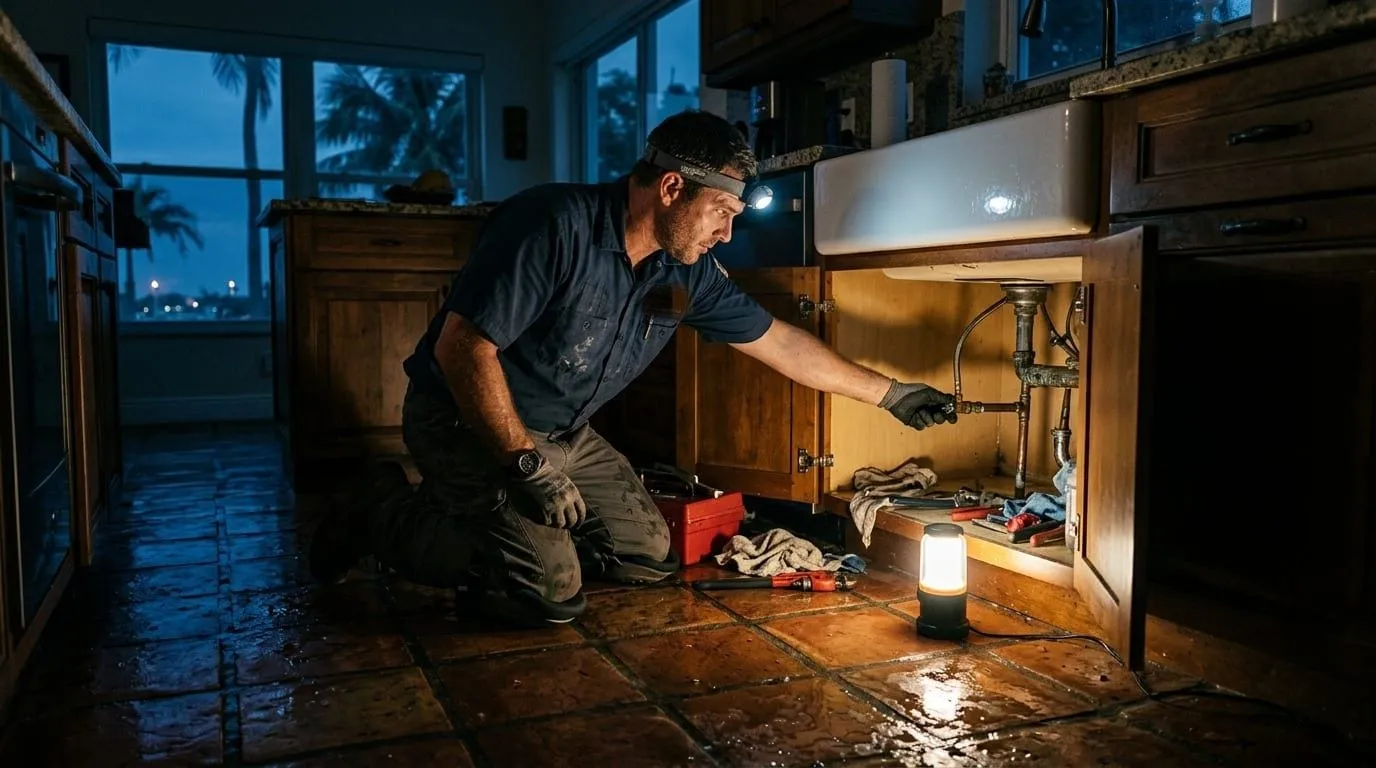
Answered at any hour · serving all three counties
Septic service, where the water table decides more than the household does
A drainfield only works with a set clearance above the water table, and that table shifts through the year here, so a system that passes in the dry months can sit underwater in the wet ones with nothing in the house changed.
Why does my septic system only act up during the rainy season?
A drainfield does not dispose of wastewater so much as release it into the soil, which requires the field to sit a set distance above the water table. That table rises and falls through the year here, and once it climbs too close, the field stops absorbing anything, no matter how carefully the household uses water.
This is not rare. Miami-Dade County alone counts more than 105,000 homes still on septic, and roughly 58,349 are compromised for part of the year, failing whenever a storm rolls through or the ground stays saturated. Where the table has risen for good, a dosing tank can keep the system compliant.
It is also why Florida’s realistic pumping interval runs shorter than the national rule of thumb. The combination of loose, sandy ground, a water table close to the surface, and a heavy wet season pushes the right pumping cadence down to every two to three years here, not the three-to-five-year window that applies elsewhere.
Worth acting on early
The signs to catch before the next wet season
Almost all of these build slowly, which is why they get ignored for too long.
Backups that come and go with the weather
A system fine all summer that fails whenever it rains hard is reporting on the water table underneath it, not on anything the household is doing.
Soggy or unusually green grass over the field
Effluent reaching the surface is Florida’s legal definition of failure, not a lawn-care issue. It counts as a sanitary nuisance.
Every drain in the house running slow at once
A single sluggish drain is about that fixture. Every drain slowing at once, on a septic system, points elsewhere: toward the tank or the field, not the household’s pipes.
Nobody remembers the last pump-out
Two to three years is the realistic window here, tighter in a bigger household. No date on the last pump-out means it is already overdue.
Municipal sewer has reached the street
Tying in is a multi-step approval process, not a single appointment. It is worth getting in motion long before a failure makes the timeline for you.
How the visit works
Sorting the tank, the field and the ground apart
Three different problems that all look identical from inside the house.
- 01
Get the basic numbers on the system
Tank size, bedroom count, and system age. Florida sets a 900-gallon minimum for up to three bedrooms, adding 150 gallons per bedroom beyond that. So an addition that never triggered a tank upgrade is a common reason a system suddenly can’t keep up.
- 02
Work out whether it’s the tank or the field
From inside the house, a tank overdue for a pump-out looks exactly like a field that has lost its buffer above the water table. The symptoms match; the fix for one has nothing to do with the fix for the other.
- 03
Give a straight answer about which one it is
If the field is the saturated one, sending a pump truck buys a little time and changes nothing underneath it. Where the ground itself is the real issue, that gets said plainly instead of sending the truck back next month.
Questions
What people want to know before calling
How often does a Florida septic tank actually need pumping?
Roughly every two to three years, shorter than the national three-to-five-year figure. Loose ground, a water table close to the surface, and heavy rainfall are the reasons why. A larger household can push that to one or two years.
Does pumping the tank fix a slow drainfield?
No. Confusing the two gets expensive. A pump-out only empties the tank; it does nothing for a field that can no longer absorb once the table rises into its buffer zone. Relief lasts weeks at best, not a fix.
What actually counts as a septic failure under Florida law?
Florida law treats it as a failure once the system discharges wastewater onto the ground or into surface water, or once it stops the house’s plumbing from draining as it should, a public sanitation problem either way. Standing water over a drainfield is never just a landscaping issue; it meets that legal bar on its own.
Should I switch to sewer if it becomes available?
Doing so takes the water table out of the equation for good. In Miami-Dade that means four separate sign-offs: the state clears closing out the old system, the county issues an allocation letter, a new plumbing permit gets pulled, and the county utility inspects and accepts the connection.
Do you work on septic systems across the whole area?
Yes, across all three counties, and it comes up most on the western and rural edges, where sewer never got built out and the systems tend to be the oldest in service.
Related work
What often turns out to be the real issue
A good share of septic calls turn out to be a different problem altogether.
Live dispatch · 24 / 7 / 365
Is the septic system already fighting the wet season?
Whoever answers, any hour, starts by working out whether this is a tank story or a water-table story, because a pump truck only fixes one of the two.
No obligation. Work performed under Florida plumbing contractor license CFC1433655.