
Answered at any hour · most houses done in two to three days
Repiping, once the supply line is failing along its length
The plumber identifies and pressure-tests the existing supply first, since the material decides everything: galvanized narrows from the inside, polybutylene lets go with no warning, and copper usually fails at a single point instead of everywhere.
How do you know a repipe is needed instead of a repair?
Whether a repair or a full repipe is right comes down to the material, not the calendar. Galvanized steel rusts closed from the inside, narrowing so gradually that the exact day pressure started dropping is impossible to name. Patching one stretch of a line closing everywhere else solves almost nothing.
Polybutylene sits in a category by itself. That gray plastic supply line, installed roughly from the 1970s to the 1990s, turns brittle and can split with zero warning, which is why it triggered a major class-action settlement, and why more Florida insurers now decline to write or renew coverage on a home that still has it.
Copper is a different animal; it tends to develop a single pinhole rather than fail wall-to-wall, so a targeted repair is often fair. But near the ocean, salt attacks copper from outside the wall as well as inside, and one leak is often a preview of the whole run’s condition.
What the house is telling you
Signs that point at the run, not one fitting
A problem at one fixture is a fixture problem. A problem everywhere is the pipe.
Pressure down at every fixture, not just one
When the whole house feels weaker rather than one tap, the restriction sits upstream of the fixtures. In a galvanized system, that means the bore is narrowing from within.
Water with a rust tint or cloudiness
Most noticeable on the first draw of the day. That color is coming off the inside of the pipe itself, and it will not correct on its own.
A second pinhole leak in copper
One pinhole can be an isolated event. A second one in the same house means the run has reached a certain condition, rather than just had bad luck.
Gray plastic supply pipe in the walls
That is very likely polybutylene, the one material here that fails with no warning symptom at all; there is nothing to wait for.
Fixing one leak only to find the next one nearby
A repaired leak followed by a new one a few feet down the same line points at the run itself, not the spot you just fixed.
How the job runs
From identifying the pipe to water back on
Four stages, and the house keeps running water through all of them.
- 01
Find out what is actually inside the walls
Galvanized, polybutylene, copper and CPVC each break down in their own way, and identifying which one is behind the wall shows whether a repair actually solves anything or just delays the larger job.
- 02
Map the route together
Which walls need to open to place the new supply, how they get closed back up afterward, and how the finish comes together, that is what decides how disruptive the week feels.
- 03
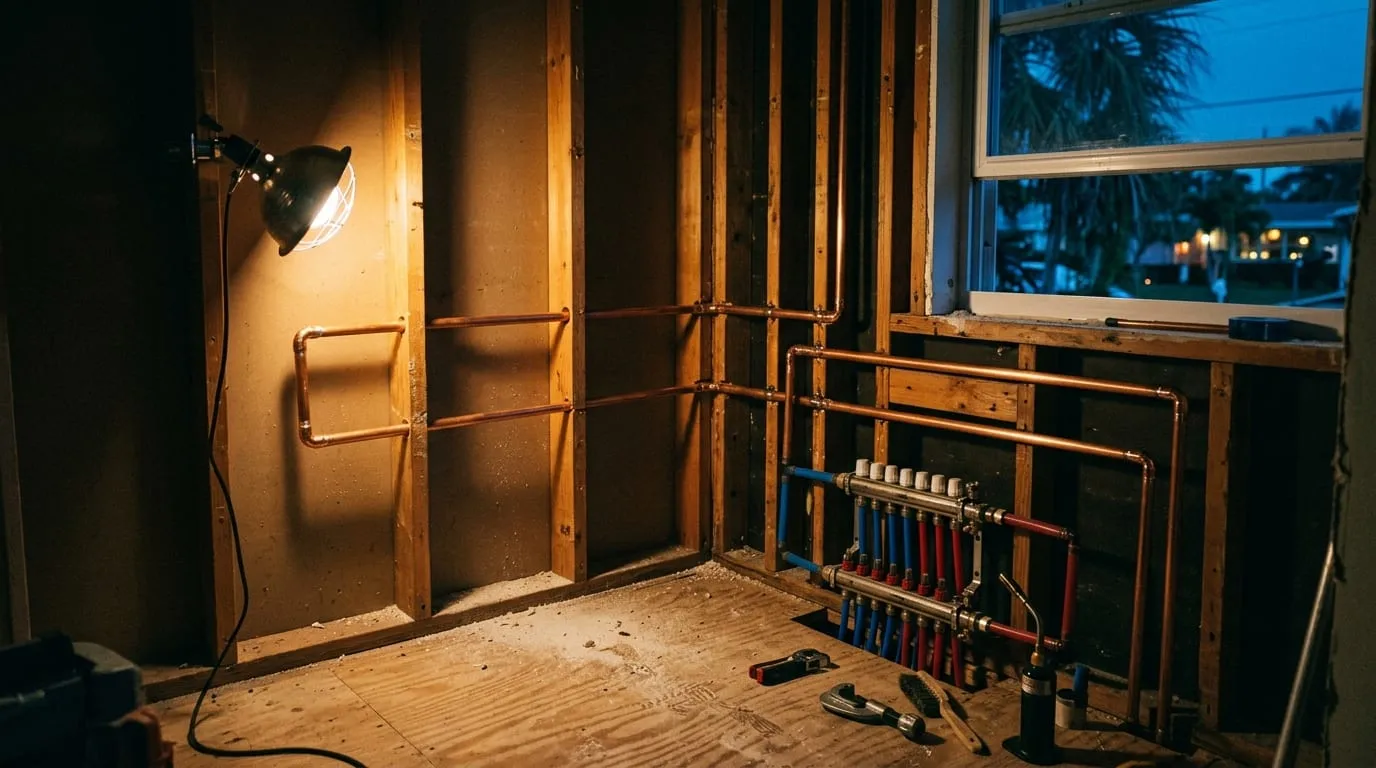
Replace the lines in stages
Count on roughly two to three days for a typical South Florida house, drywall patching included. Water comes back on every evening once that day’s work wraps, rather than staying off for the whole project.
- 04
Pressure-test, get it inspected, close the walls
Every new line is tested before it disappears behind drywall, and a record of what was replaced versus left in place goes with the job, useful if it ever needs proving.
Questions
What homeowners ask before a repipe
Will the house be without water for several days?
No. A typical house is finished in two to three days, drywall patching included, with water back on at the close of each working day rather than staying off until the job is done.
Copper, PEX or CPVC: which is better?
Copper has the longest history behind it. PEX flexes and avoids the chlorine-related brittleness that did in polybutylene. CPVC is rigid and turns up constantly in residential jobs. Which one fits comes down to the house and the planned route, and the trade-offs get explained rather than just handed to you as a verdict.
How can I tell if my house has polybutylene?
Look for gray plastic supply lines, common in houses built or replumbed from roughly the 1970s through the 1990s. Worth checking proactively, since unlike the others here, it gives no symptom before it fails.
Is a partial repipe ever enough?
Sometimes. A point failure in copper is a fair repair on its own. But a line narrowing or turning brittle along its length usually means paying to finish the rest later, and that trade-off gets said up front, not discovered afterward.
Do you patch the walls when it’s done?
Drywall patching is included in that two-to-three-day window. Paint and texture matching are a separate trade, flagged at the start of the job, not the end of the invoice.
Related work
What tends to lead to a repipe, and what follows one
A repipe is rarely anyone’s first call; it tends to follow one or two other repairs already tried.
- Leak detectionpins down the first leak before the bigger decision
- Emergency plumbingfor when a line has already given out
- Cast iron replacementthe same decision, on the drain side of the house
- Water heater replacementfrequently scheduled in the same visit
- All servicesthe rest of the twenty services we run

Live dispatch · 24 / 7 / 365
Every tap losing pressure, or found a second pinhole?
Whoever picks up is a real person, any hour you call, and the first move is pinning down what material is actually in your walls before anyone mentions a repipe.
No obligation. Work performed under Florida plumbing contractor license CFC1433655.