
Answered at any hour · camera first, verdict second
Hydro jetting, for the drain line that keeps needing the same fix
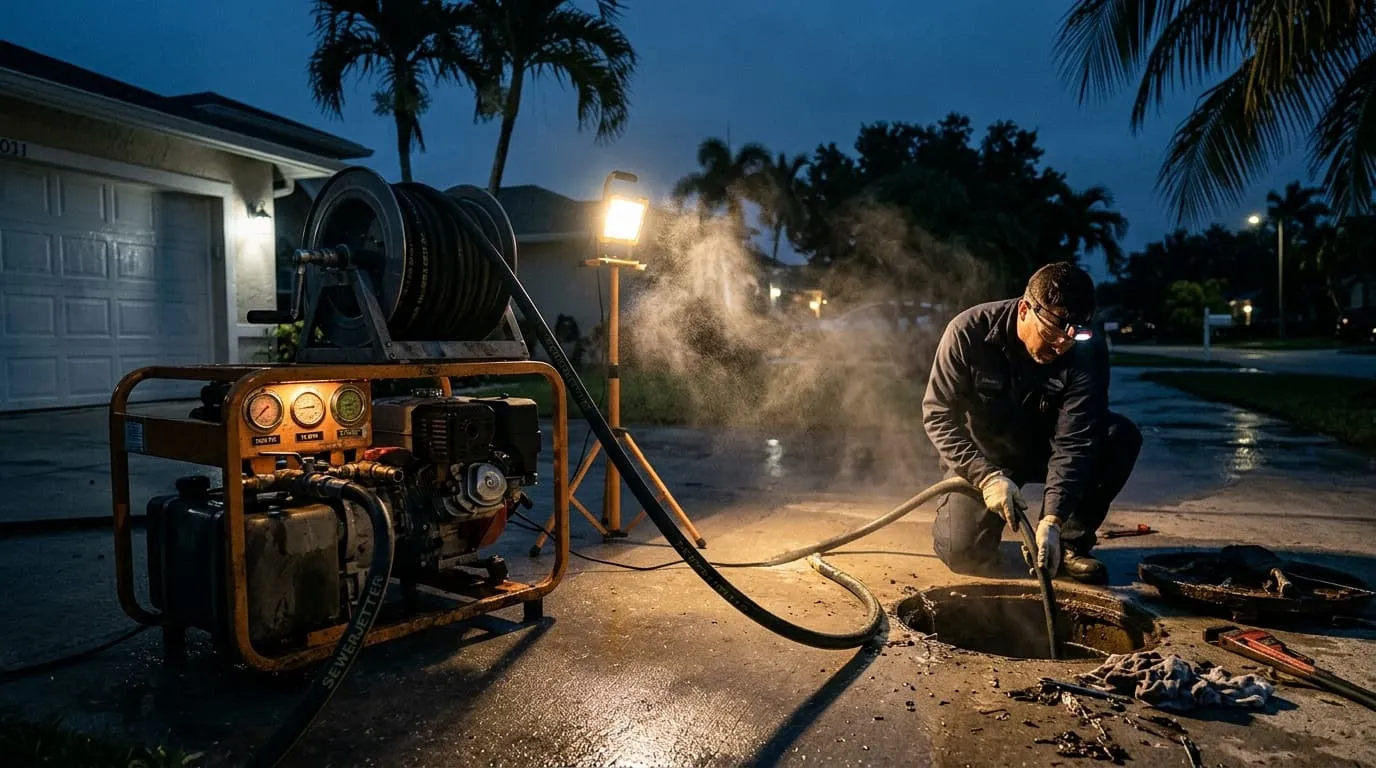
Pressurized water near three to four thousand PSI scrubs the inside wall of the pipe instead of drilling a channel through whatever is blocking it: the distinction that matters once grease, not an object, is the actual cause.
Why does a snaked drain clog again so quickly?
The tool decides the answer. A cable drills a two-to-three-inch opening through whatever is blocking the line, and flow returns right away, but it never touches the coating stuck to the pipe wall around that opening. On a grease line, that leftover coating is still there when the truck pulls away, narrowing the drain shut again.
A jetter solves a different problem. Water pushed through a nozzle at three to four thousand pounds per square inch strips that coating off the wall and hands the pipe back its full working diameter, instead of opening a narrow tunnel through the debris. On a grease-fouled line, that is a different mechanism entirely, not cabling turned up a notch.
The gap in how long each one holds is not small. A cabled grease line commonly needs clearing again within a few months. A jetted line on pipe that is structurally sound typically stays open for two to four years.
When jetting earns its keep
Signs the wall itself is the problem
The question worth asking is not how to reopen the line again, but why it keeps narrowing.
The same line, on a repeating schedule
A clog that returns on something close to a fixed interval is telling you the last visit cleared the symptom and left the cause standing. Something keeps rebuilding on the wall between calls.
A kitchen drain feeding several units, or one busy one
Grease is the usual culprit. A restaurant line, or a stack shared by several households, carries a steady load that a cable can never get ahead of; it only ever catches back up.
Roots returning after every cutting
A cutting head opens a path through root mass without removing it. Jetting flushes the cut material out of the pipe, though a root problem is also worth a camera look, since roots only get in through a defect.
Sluggish everywhere, not stuck at one spot
A line that drains slowly along its entire run, rather than backing up behind one obstruction, has lost interior diameter across the board, a wall condition, not a blockage.
The sequence
A look before the pressure, and sometimes instead of it
Three stages, and the first one occasionally ends the conversation on its own.
- 01
Look at the pipe before it gets pressurized
Jetting assumes the pipe underneath the buildup is still structurally sound. Cast iron that has already thinned and scaled cannot take that pressure safely, and a camera is the only honest way to tell the two apart before committing to the job.
- 02
Work the line with water, not force at one point
The jetter is walked the length of the run near three to four thousand pounds per square inch, cutting the coating off the wall in passes rather than blasting straight at the clog, and flushing everything it removes out through the cleanout.
- 03
Camera it again to see what was hiding
A pipe wall that has been coated for years becomes visible for the first time. A crack, or a low spot holding water underneath the buildup, shows up in that footage now, instead of turning into a callback twelve months later.
Questions
What people ask before booking a jetting visit
Can jetting break my pipes?
Only on pipe that has already deteriorated, which is precisely why a camera inspection comes before the equipment does. Cast iron already showing heavy scale and thinning calls for a different conversation entirely, likely replacement rather than pressure. Running a jetter through a line nobody has looked at first is a gamble taken with your plumbing, not theirs.
How long will the line stay clear?
On pipe that is still sound, two to four years is typical, against a matter of months for a cabled line. If a freshly jetted line clogs again fast, that itself is a finding; it usually points to a structural defect the camera pass already flagged.
Isn’t this just a stronger snake?
No. The mechanism is different, not just the intensity. A cable opens a channel through the blockage. A jetter takes the coating off the pipe wall entirely. For a grease-driven clog, only the second one removes the actual cause.
Does a house need this done on a schedule?
Rarely. A single-family home usually only needs jetting when a specific line is already showing the signs above. A commercial kitchen with a constant grease load is the case where a standing interval can make sense, and that call follows what the camera shows rather than a fixed calendar.
Related work
The jobs that sit next to a jetting visit
Jetting is usually one move in a longer sequence, not the entire answer by itself.
- Sewer camera inspectionconfirms the pipe can take the pressure first
- Drain clog repairfor a blockage rather than a coated wall
- Sewer line repairfor whatever the second camera pass turns up
- Cast iron replacementfor pipe too far gone to pressurize
- All servicesnineteen more, from leak detection to backflow
Live dispatch · 24 / 7 / 365
Same drain backing up on you again?
A live person takes the call at any hour. The line gets a look before any pressure gets applied, and that look occasionally rewrites the whole plan.
No obligation. Work performed under Florida plumbing contractor license CFC1433655.