

Answered day and night · tested before storms, not during
Sump pump service, for a region with no basements to protect
The float, the pump and the line it discharges into get tested together as one system, since the pump itself is rarely the part that actually failed first.
Why would a property in this region need a sump pump at all?
Basements do not exist in this region, so that is not the concern. A sump pump here earns its keep wherever a structure dips below the grade around it while the water table sits close beneath: think of an elevator shaft, a ramp or garage set below street level, a mechanical room, the crawl space under an older stilted house, or a low corner of a lot that collects water faster than the ground can absorb it.
That changes what a failure actually looks like. Elsewhere, a failed pump means a wet basement floor. Here, it means a flooded elevator shaft and a lift pulled out of service, or water climbing a garage wall with no slope anywhere to carry it away.
There is a scheduling lesson buried in this too. A sump system proves its worth only on the days water actually shows up, and around here that means hurricane season, so the smarter time for a checkup is springtime, before the forecasts start naming storms.
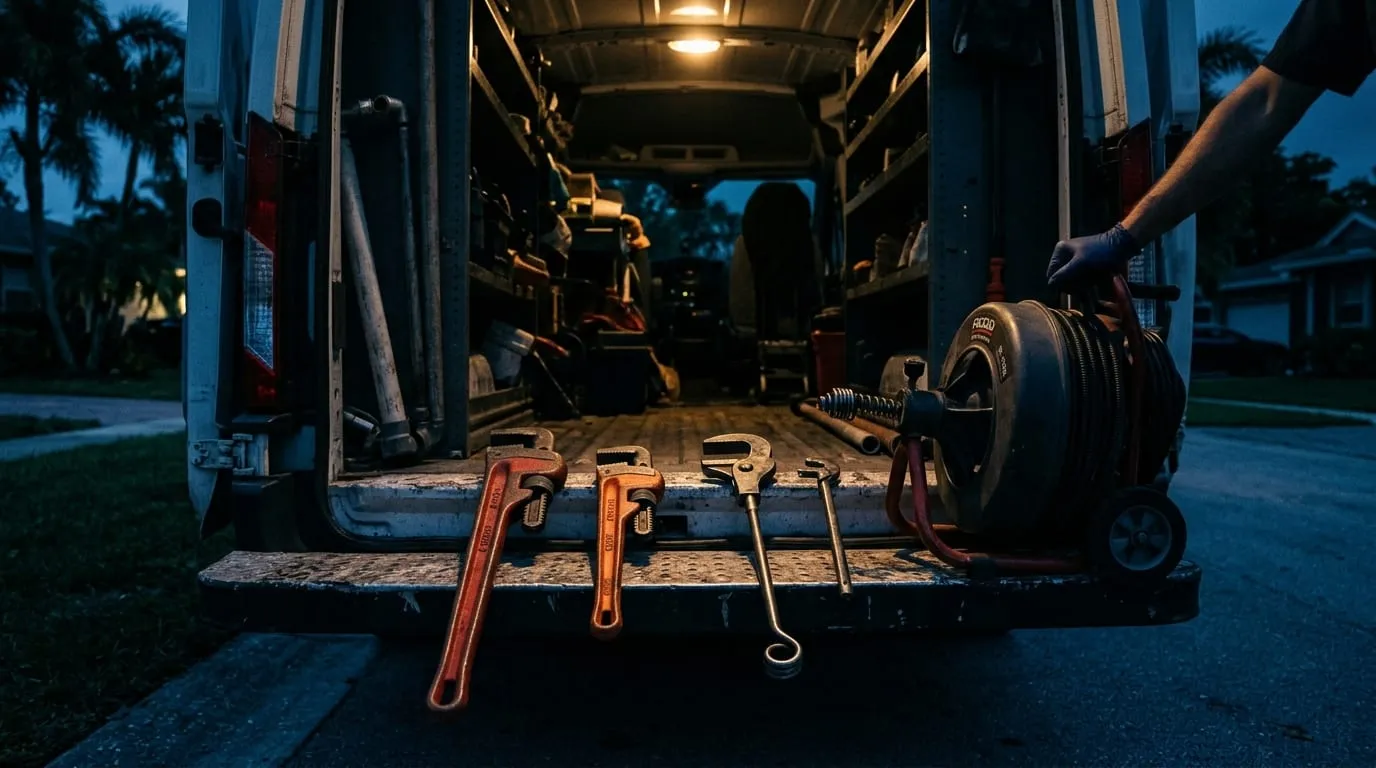
What you are seeing
Four ways a sump system actually fails
Only one of the four is the pump itself.
The float has stuck in place
By far the most common failure. The pump itself is fine; the switch telling it to start is not, and often nobody knows until the pit is already full.
The discharge line is blocked or disconnected
If the pump keeps cycling but the standing water refuses to drop, it is sending that water somewhere useless. Trace the discharge line to its actual endpoint before assuming the pump itself is at fault.
It runs almost without stopping
Two possible culprits, with very different fixes: a failing check valve letting pumped water slide back down into the pit, or a water table pushing in faster than the unit was ever sized to handle.
It has simply never been tested
A motor that sits idle for a year risks seizing the moment it is finally needed. Where the pit is guarding something like an elevator, that risk is worth ruling out on a calendar, not discovering during a storm.
Questions
Straight answers before you call
What is the actual way to test a sump pump?
Add water to the pit by hand until the float lifts and the motor kicks on, then watch whether the level actually drops and the pump shuts itself off afterward. Doing that once exercises all three components (float, motor and discharge) in a single pass.
The pump runs almost constantly. Is that something to worry about?
Yes, enough to look into it rather than shrug it off. A worn check valve can let already-pumped water slide straight back down, so the unit ends up moving the identical gallon over and over. Alternatively, incoming groundwater may simply outpace what the pump was built to handle, and that calls for a different repair altogether.
Is a backup pump worth having?
It depends what sits behind the primary pump. Where the consequences of a failure are expensive, a backup earns its cost, partly because storms strong enough to flood a pit are also the storms most likely to cut electricity. That is a judgment call based on what the pit is protecting, not a universal rule.
When is the right time to have this looked at?
Ahead of the season, never during it. A sump pump justifies itself only on the handful of days it actually has to work, so a spring checkup is routine while a first-ever look in the middle of a September storm already counts as an emergency call.
Related work
Other systems that share the same water table
The conversation about grade and groundwater rarely stays confined to one appliance.
- Well pumpsthe other pump doing quiet work on the property
- Emergency plumbingfor the moment the pit has already overflowed
- Leak detectionwhen the water traces back to a pipe, not the ground
- Septic servicesthe other system a high water table complicates
- All servicesnineteen more, from disposals to backflow
Live dispatch · 24 / 7 / 365
Water rising in the pit, or a pump nobody has tested?
The phone gets picked up at any hour, and the visit covers the float, the motor and the discharge together instead of guessing which single part let go.
No obligation. Work performed under Florida plumbing contractor license CFC1433655.