Fifteen to twenty feet to water
That is the maximum depth before a shovel strikes the water table almost anywhere in the city, and it is the constraint behind nearly every excavation, slab repair and lateral job here.
Miami-Dade County · answered now
Dispatch notes the address and what kind of building sits on it, because a Brickell high-rise and a 1922 house on Coral Way call for two different kinds of plumber before either truck leaves the yard.
Why does Miami’s water table complicate every plumbing repair?
Because you cannot put a shovel more than fifteen or twenty feet into the ground here before striking water. That single limit is why the region’s rail transit runs above ground rather than under it, and why an excavation here is never quite the same job as the same dig a few miles inland.
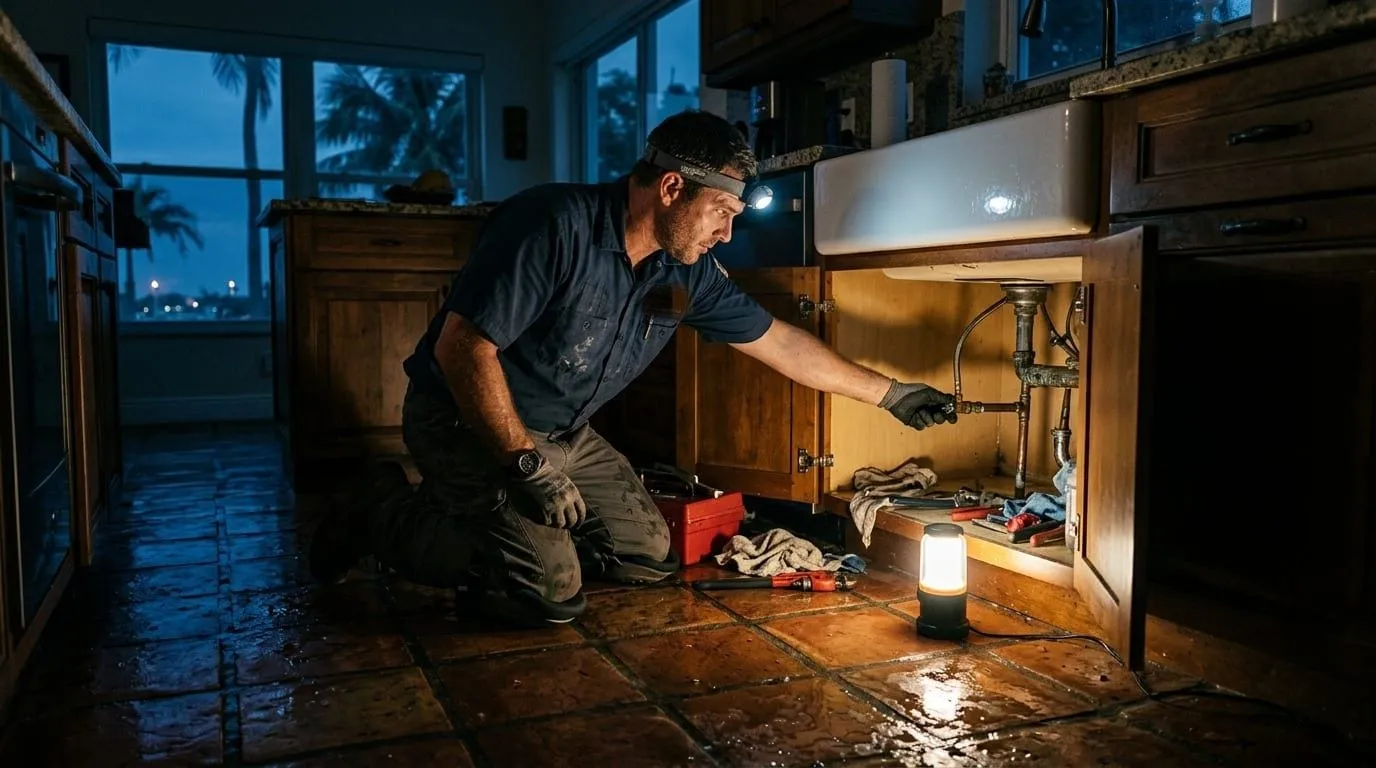
For a plumber it changes two things at once. A pressurized line failing under a slab has no way to drain downward, so water spreads sideways through the fill until it finds a seam in the floor, which is why the wet spot rarely sits above the actual break. Any repair that goes deep, on a lateral or a main, fights groundwater instead of dry ground.
Beneath the eastern half of the metro area runs the Miami Rock Ridge, a limestone shelf whose highest point (twenty-four feet, in Coconut Grove) is about as close to high ground as this city gets.
What’s beneath the city
Thirty-six square miles spanning nearly every building era South Florida has produced.
That is the maximum depth before a shovel strikes the water table almost anywhere in the city, and it is the constraint behind nearly every excavation, slab repair and lateral job here.
Miami incorporated in July 1896 with roughly 300 residents and had grown to nearly 250,000 by 1950. Much of the housing built during that boom predates PVC, meaning cast iron drains and, in the earliest pockets, galvanized supply.
Some pockets of this city predate almost everything else in the region we cover, old enough that galvanized steel supply lines are a real possibility right alongside cast iron drains.
A limestone shelf runs beneath the eastern side of the metro area. Its highest natural point, twenty-four feet above sea level, sits in Coconut Grove, about as much elevation as this region gets.
Miami-Dade County is made up of 35 municipalities, and each runs its own building department and its own building official. Cross a city line here and the permit process can change with it.
What breaks, and where
High-rises, pre-war houses and the ground itself each produce a different kind of call.
Water only fifteen feet down has nowhere to drain to, so an escaping line pushes sideways through the fill instead and surfaces wherever the floor happens to let it through. Cut into the slab at the visible spot and there is a real chance the actual break is somewhere else entirely.
Get the break located before any concrete comes up.
Leak detectionAnything built in the 1920s or earlier came before copper was the standard supply material. Galvanized steel narrows from the inside instead of bursting outright, so pressure fades at every fixture at once, slowly enough that no single day looks like the day it happened.
Check pressure at the meter against pressure at a tap.
RepipingIn Brickell and the other high-rise pockets, what actually failed is usually a stack or riser the whole column of units shares, not a fixture inside any single unit, so whoever reports the water is often not the one whose plumbing gave out.
Log the time it started and notify the building.
Sewer camera inspectionNeighborhood by neighborhood
History runs so deep here that the neighborhood name doubles as a construction date.
Settled in 1825, and sitting on the highest natural ground in the city (twenty-four feet, on the Rock Ridge). About the only neighborhood here where elevation does you any favors.
Coral Way dates to 1922. This pocket is pre-war and inter-war housing, the kind where galvanized supply and cast iron drains can both be hiding in one house without either being visible.
Almost entirely high-rise. A leak here is more often a shared stack or riser than a single unit’s problem, and reaching it means going through building management and a scheduled shut-off.
Inland neighborhoods that grew during the boom that carried the city to nearly 250,000 residents by 1950, squarely cast iron territory, with the recurring drain trouble that era brings.
Who to call
One utility for the county, thirty-five permit offices inside it.
Reviews
Pulled directly from the company’s Google Business Profile, each one credited to the reviewer’s public name.
A selection of our 5-star reviews on Google.
See all reviews on GoogleId be completely comfortable having them back for future plumbing work. Everything about this visit was straightforward and well handled.
He even explained which work wasn't worth spending money on yet. That's the kind of honesty that makes me want to call someone again.
Nothing about the job looked rushed. From the repair itself to the final testing, everything was handled carefully and professionally.
Questions
Because the water table sits only fifteen to twenty feet down almost everywhere in the city, so a line that fails underground has no room to drain downward. It travels sideways through the fill instead and shows up wherever the floor happens to give, meaning the wet patch tells you a leak exists, not where it is.
Galvanized steel supply lines are a genuine possibility, often alongside cast iron drains, plus a hundred years of partial repairs done by whoever was on the job at the time. The build year narrows down the likely culprit, and a camera inspection with a pressure check confirms it.
Usually not. Water moves downward, so in a high-rise the source is typically the unit above yours or a shared riser, and a shared riser belongs to the association, not to you. Figuring out which one it is before anything gets opened is what keeps you from covering someone else’s repair.
The City of Miami handles it inside city limits, but that answer only holds inside those limits. Miami-Dade has 35 separate municipalities, each with its own building official, so the identical job one mile over can mean a completely different department.
Close by
No other city we cover shares more county line with its neighbors.
Live dispatch · 24 / 7 / 365
A person picks up at any hour, talks you through the shut-off if you need it, and routes a plumber to your address.
No obligation. Work performed under Florida plumbing contractor license CFC1433655.