
Seven variables · never a price
What actually makes one water heater replacement bigger than another
Seven factors decide how large a water heater replacement becomes, and the heater itself is rarely the biggest one. This site publishes no prices, on purpose.
The heater itself is rarely what changes the scope. What changes it is everything code now requires to be brought current the moment the old tank comes out, plus whatever the space around it will or will not allow.
Why can two water heater jobs on the same street look so different in scope?
The appliance is frequently the smaller part of the job. A replacement is the moment an installation is brought up to current code, and how much that involves depends on when the original went in, what was installed alongside it, and where in the building it sits.
This site never attaches a number to that job, or to any other, and that is a deliberate policy, not an oversight. A figure that skips the venting, a possible pan or expansion tank, the gas or electrical hookup, and how hard the unit is to reach is not really a quote; it is a way to get a foot in the door. What follows instead is a rundown of what actually moves that number.
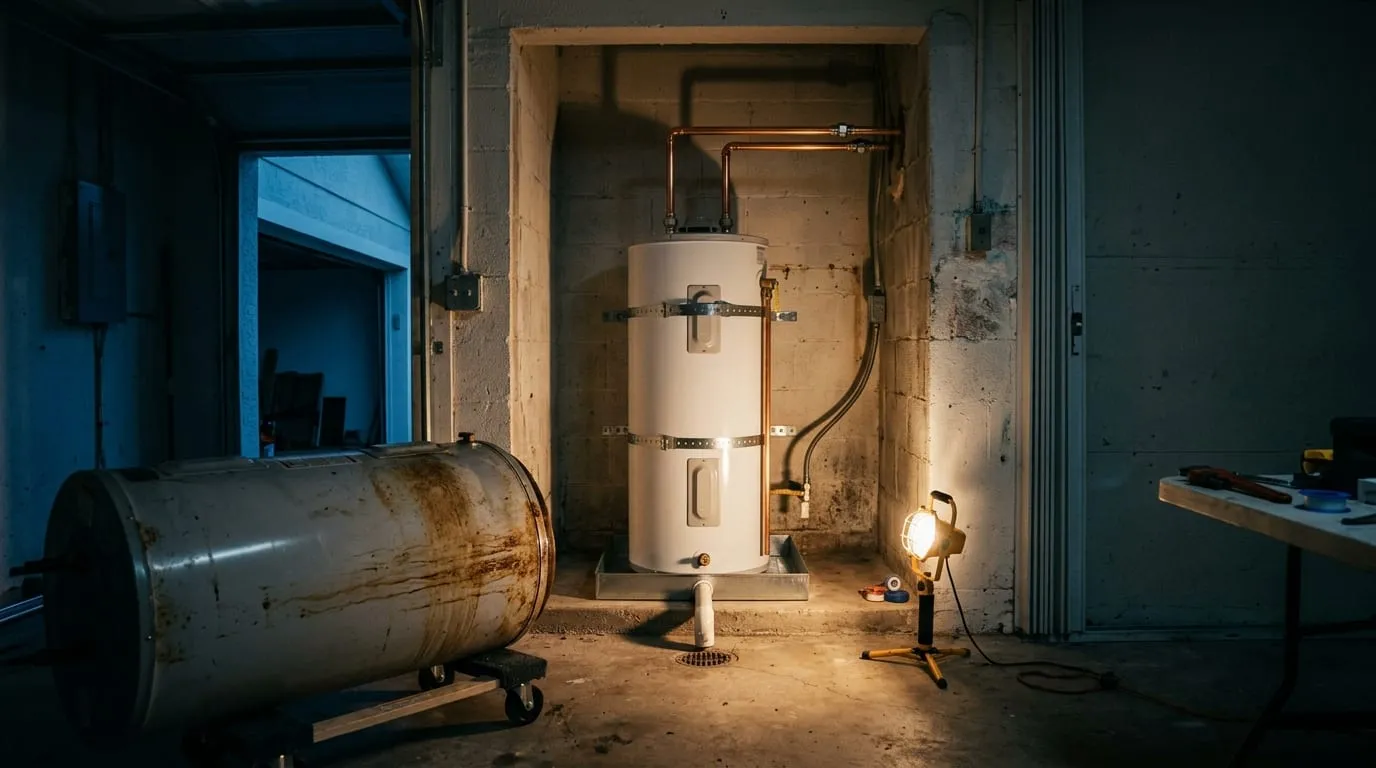
Before requesting any estimate, take a photograph of the current tank together with its hookups and whatever surrounds it. Almost every variable discussed below shows up somewhere in that one image.
Seven variables, ranked by frequency
The seven things that actually change the scope of the job
These seven are ordered by how often each one turns out to be the reason a job grew, not by which sounds most dramatic.
1. Staying with the same type of unit
Swapping a tank for another tank of the same kind is the plainest version of this job, because the connections, the footprint and the capacity are already matched to it. Switching type (most often tank to tankless) is a different undertaking altogether: it changes what the gas or electrical supply has to deliver, changes how the unit vents, and changes where it can physically be located. That is a conversion, not a replacement, and calling it what it is keeps the two from being compared as though they were the same job.
2. What current code adds that the old installation never had
This is the surprise that comes up most often, and no contractor is inventing it to pad the job. A replacement has to satisfy whatever the code in force today demands, and that usually means adding a properly routed relief valve for temperature and pressure, plus an expansion tank on any house running a closed system. Where the original install predates those rules, catching up to them is simply folded into this job.
3. The drain pan, and a detail rarely explained
Where a leaking tank would cause damage, a pan is required, no less than an inch and a half deep, with drainage through an indirect waste pipe measuring three-quarters of an inch or more. What is rarely explained is that where a pan drain was never installed in the first place, a replacement is not automatically required to add one. So it is a real conversation about the specific installation, not a mandatory line item either way.
4. Where the unit is actually located
A tank standing in an open garage with room on every side is the easy version. The same unit tucked in a closet, set in an attic, sitting above a finished ceiling, or reached only by a flight of stairs takes considerably more effort to remove and to carry back in, and that access cost is not something a photograph of the tank itself will ever show. In a condominium there can also be rules about where a unit is allowed to sit at all.
5. The condition of everything the unit connects to
A shutoff valve that will not fully close anymore, fittings eaten by corrosion, flexible connectors near the end of what they are rated for, supply pipe grown thin around an old joint: none of that is technically required by a replacement, yet all of it becomes hard to walk away from once the system is already opened up and a unit meant to serve for the next decade or more is going back in.
6. Gas, electrical and venting together
Gas brings venting and a combustion-air supply along with it, and neither is optional; both are life-safety items. Electric brings a dedicated circuit, and that circuit’s rating and condition come along with it. Whenever a replacement bumps up capacity or switches type, one of these two can end up dwarfing every other line in the job, which is precisely why comparing a tankless conversion to a simple swap misses the point.
7. The permit, and the inspection that comes with it
A water heater swap draws a permit and an inspection in most cities across this part of the state, since one job simultaneously touches gas or electrical safety, how efficiently the unit runs, how pressure is controlled, and how it vents. Miami-Dade layers on a county utility review whenever water or sewer service is affected. A number that comes in smaller because the permit was left out has not actually gotten cheaper; it has gone unpermitted, and that tends to resurface later, at closing, at an inspection, or when an insurance claim gets filed.
What to request instead of a number over the phone
Ask for a written scope. It should name the actual unit, state plainly whether an expansion tank, a pan, a pan drain, the temperature-and-pressure discharge line, venting work and electrical work are included or excluded, say who is pulling the permit, and say what happens to the old unit afterward. Two scopes written that way can genuinely be set side by side. Two bare numbers cannot.
Questions
Questions people ask before replacing a water heater
Why does this site not list prices?
Because a number missing the venting work, a possible expansion tank or pan, the hookup itself, how hard the unit is to reach, and the permit fee is not a meaningful price for any particular job. It is a stand-in figure, not a quote. Nothing on this site carries pricing, for any service, so that whatever figure eventually reaches you is the real one.
Is an expansion tank actually required?
Current code calls for one whenever the house runs a closed system, and a replacement is exactly when that requirement gets enforced. Confirming whether a given system is closed happens on site during the visit, and asking the installer to walk through that finding is entirely reasonable.
There was never a pan under the old tank. Must one be added now?
Not necessarily. A pan is required where a leak would cause damage, but where a pan drain was never installed to begin with, a replacement is not automatically required to add one. It is worth discussing based on the specific location rather than assuming it either way.
Is switching to a tankless unit worth doing at the same time?
That question belongs to conversion, not replacement, and the two get compared unfairly all the time. Swapping tank for tankless rewrites the venting and reworks whatever the gas or electrical supply has to deliver, and it is those changes, not the appliance itself, that actually drive the decision. Weighing a tankless conversion against a simple like-for-like swap on cost alone measures two different projects with the same ruler.
Can a homeowner supply the water heater and have it installed?
Some people do. What is worth understanding first is how that affects the warranty and who is responsible if the unit itself turns out to be defective. It works as an arrangement as long as both sides put in writing what each one is covering.
How does a homeowner know it is actually time to replace one?
Age is the biggest indicator, alongside rust-tinted hot water, rumbling or popping from sediment, moisture collecting at the base, or a recovery time that has been quietly getting slower. A tank that has started leaking from its own shell is past repairing, and in a closet or an attic that situation is worth acting on before it becomes a much larger water-damage claim.
Live dispatch · 24 / 7 / 365
Reading this because of an actual problem?
The phone is answered at any hour by a person who can walk you through the shut-off and get a plumber moving your way.
No obligation. Work performed under Florida plumbing contractor license CFC1433655.