
Two repair methods · one camera decides
Trenchless or traditional sewer repair: what the pipe’s condition actually decides
Neither method wins by default. A sewer camera reports the pipe’s actual condition first, and that finding decides between lining, bursting or open excavation.
A liner needs a passage that still exists. Where the pipe is intact enough to thread one through, lining skips the digging; where it has collapsed or shifted out of line, no liner fixes that, and admitting it separates diagnosis from a sales pitch.
Is trenchless sewer repair better than traditional excavation?
Neither wins as a rule. The two approaches answer different conditions, and which condition your line is in is something a camera reports, not something either side gets to prefer. An opinion offered before the camera has traveled the pipe is worth very little.
Trenchless covers two methods. Cured-in-place lining pulls a resin-saturated liner through the existing pipe and cures it into a fresh sealed pipe nested inside the old shell, with manufacturers rating its design life at roughly fifty years. Pipe bursting instead shatters the old pipe outward while dragging the replacement through behind it, fitting a line too deteriorated to line but whose original path still works.
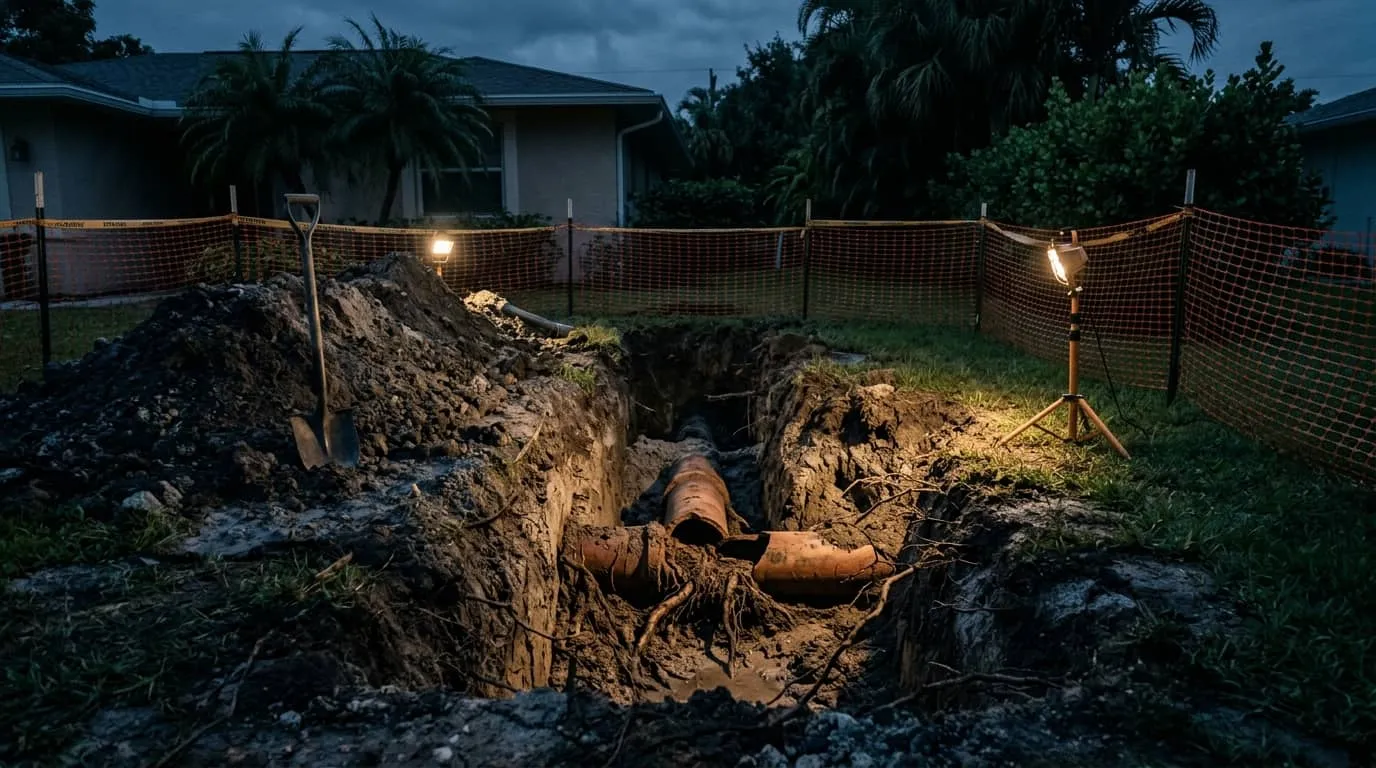
Traditional replacement removes the pipe entirely: crews cut into the slab or yard, pull out what failed, and set new pipe into the open trench. The disruption is greater and the timeline longer, yet a handful of conditions still leave excavation as the only method that genuinely holds.
Reading the inspection
What the inspection shows, and which method each finding allows
The more useful question is not which method but which finding. Everything below is something an inspection can report, and each finding points toward one answer rather than the other.
Cracked, leaking, or root-damaged, but the bore still open
This is precisely the condition lining exists for. The pipe has lost its integrity (cracks, leaks, roots working through a joint), but its shape and its path are still there to work with, so a liner can restore one continuous sealed surface without any digging. Root intrusion in particular is worth lining rather than cutting out repeatedly, because the roots return through the same joint every time, and nothing about the local climate makes them go dormant for part of the year.
Collapsed, or badly offset at a joint
Here lining runs out of road, and honesty about that boundary matters more than anywhere else in this decision. Pulling a liner through requires a continuous channel to travel down. Once a stretch has caved in on itself, or two segments have drifted so far apart that the bore no longer tracks straight, the channel simply is not there, and no amount of cleaning or prepping invents one. What remains is pipe bursting, provided the buried route can still be reused, or taking the section out through the ground.
Too blocked to clean or cable through
This also blocks lining, at least for the moment. The pipe has to be cleared before a liner can go in, and if it cannot be cleaned out or cabled through, there is nowhere for that liner to travel. Jetting often resolves exactly this, at which point lining is back on the table. It is a sequencing problem more often than a permanent dead end.
Failing in one section, sound everywhere else
Worth separating from the rest because it changes the scale of the job rather than which method applies. A single failed length under a driveway is a much smaller undertaking than a line that has thinned evenly along its entire run, and only the inspection footage tells the two apart. This is the situation where a second opinion earns its keep, in either direction: confirming a small job really is small, or confirming a large one really is large.
What this particular ground does to buried pipe
Sandy soil, a water table that sits close to the surface, and a wet season the calendar guarantees every year shift buried pipe here in ways a drier climate never has to account for. Shifting ground is exactly what knocks joints out of alignment and takes lining off the table, so a run that once qualified cleanly can stop qualifying within a few seasons. That same dampness eats through cast iron faster than dry soil would, which is a large part of why this decision keeps landing on homes from the cast-iron era of the mid-1900s.
What to ask before agreeing to either method
- Can the actual footage be reviewed? A description of the findings is not the same thing. The footage itself is what any recommendation rests on, and handing it over should need no persuading.
- Is this the whole line, or one section of it? And if it is the whole line, what the camera showed in the stretches that are not currently causing trouble.
- How are the branch connections handled? A liner has to reinstate every point where a branch joins the main, and it is fair to ask how that step is done.
- What is the permit situation? Sewer work is permitted, inspected work in this region, and a contractor should answer that question without hesitating.
- What gets restored afterward? For excavation this is usually the bulk of the disruption: slab, flooring, landscaping, driveway. It belongs in any real comparison between the two methods.
The honest version
Trenchless really is less disruptive, and for a large share of the failures that show up here, it is the right call. It is also oversold as universally superior by people who only offer that one method, and it has a genuine limit. Recommending lining without ever looking inside the pipe, and ruling lining out without looking either, are the same mistake wearing two different faces, a method decided before anyone looked at the finding.
Questions
Questions people ask about lining a sewer line
Does a liner reduce how much the pipe can carry?
Slightly, because the liner material itself takes up a bit of room inside the old pipe. What it gains back in practice is a smooth, unobstructed interior in place of a corroded and built-up one, and that trade is usually why the narrower bore goes unnoticed.
What is the expected lifespan of a liner?
Manufacturers list a design life of roughly fifty years, in the same range the original pipe was rated for when it was new. Just as important as the material is whether the line was actually a good candidate for lining and whether it was cleaned and prepared correctly before installation.
Can every sewer line be lined?
No, and it is worth pressing anyone who suggests otherwise. Lining requires an existing passage to pull the liner through. A collapsed section, a joint that has shifted out of alignment, or a line that cannot first be cleaned and cabled through all take lining off the table.
Does trenchless always cost less than digging it up?
Not necessarily, and judging the two methods on the pipe work alone can mislead in either direction. Excavation carries the cost of restoring whatever sat above the pipe, while lining carries its own preparation and access requirements. A comparison only means something when both quotes describe the same finished result.
Is a permit required regardless of which method is used?
Yes. Both approaches count as permitted, inspected sewer work throughout this region, and in Miami-Dade a job that touches water or sewer service brings in a separate utility reviewer on top of the municipal permit. Watch how a contractor talks about that requirement. Treating it as optional previews how carefully the rest of the job gets handled.
How can I confirm the repair actually worked?
The same tool that found the problem verifies the fix. A camera pass after the work is finished, recorded and handed over, shows the completed interior from end to end. Asking for it up front is a normal request, and far easier to arrange before the crew packs up than after.
Live dispatch · 24 / 7 / 365
Reading this because of an actual problem?
The phone is answered at any hour by a person who can walk you through the shut-off and get a plumber moving your way.
No obligation. Work performed under Florida plumbing contractor license CFC1433655.