
Guides
Why cast iron drain lines fail early here, and how to tell where yours stands
Cast iron drains carry a 40-to-50-year rating, but Florida’s soil and humidity push many to fail at 25 to 30. The first warning is a drain that keeps blocking.
Cast iron rusts from the inside. As the bore roughens, it starts snagging everything that flows past, and the clog a household blames on itself is often just the pipe reporting its own condition.
Why do cast iron drains fail sooner in South Florida?
Corrosion is what kills cast iron, and few places are harder on it than South Florida. Cast iron drains show up mainly in houses built between 1945 and 1975, rated for roughly 40 to 50 years of service. Between the humidity and soil chemistry here, a large share of that stock starts failing at 25 to 30.
The damage runs from the inside out. Rust builds along the bore, the once-smooth interior turns rough and scaled, and the pipe’s usable diameter steadily narrows. From there, the roughened wall starts snagging grease, hair, paper and mineral buildup that a healthy pipe would simply pass along.
That is why the sign worth watching for isn’t one dramatic event but a pattern: the same drain backing up in the same spot two or three times a year. That points to a pipe near the end of its life, not a household with bad habits. Clearing the line again only buys time against the real cause.
The mechanism
From a rated lifespan to a repeat clog to a hole underfoot
Cast iron was a solid material, and a great deal of it gave fifty honest years of service. It comes up so often here not because it was a poor choice, but because this climate shortens its working life, and a huge wave of housing hit the end of that life at roughly the same time.
How it actually plays out
The failure tends to follow a fairly consistent order, which lets a homeowner place their own house somewhere on it.
- Scaling. Rust and mineral buildup coat the inside of the pipe wall. Nothing shows up in the house yet, and drains still run close to normal, maybe fractionally slower.
- Snagging. The roughened interior begins holding on to debris that would otherwise pass through. Drains slow down, then clog, then get cleared, then clog again in that same spot.
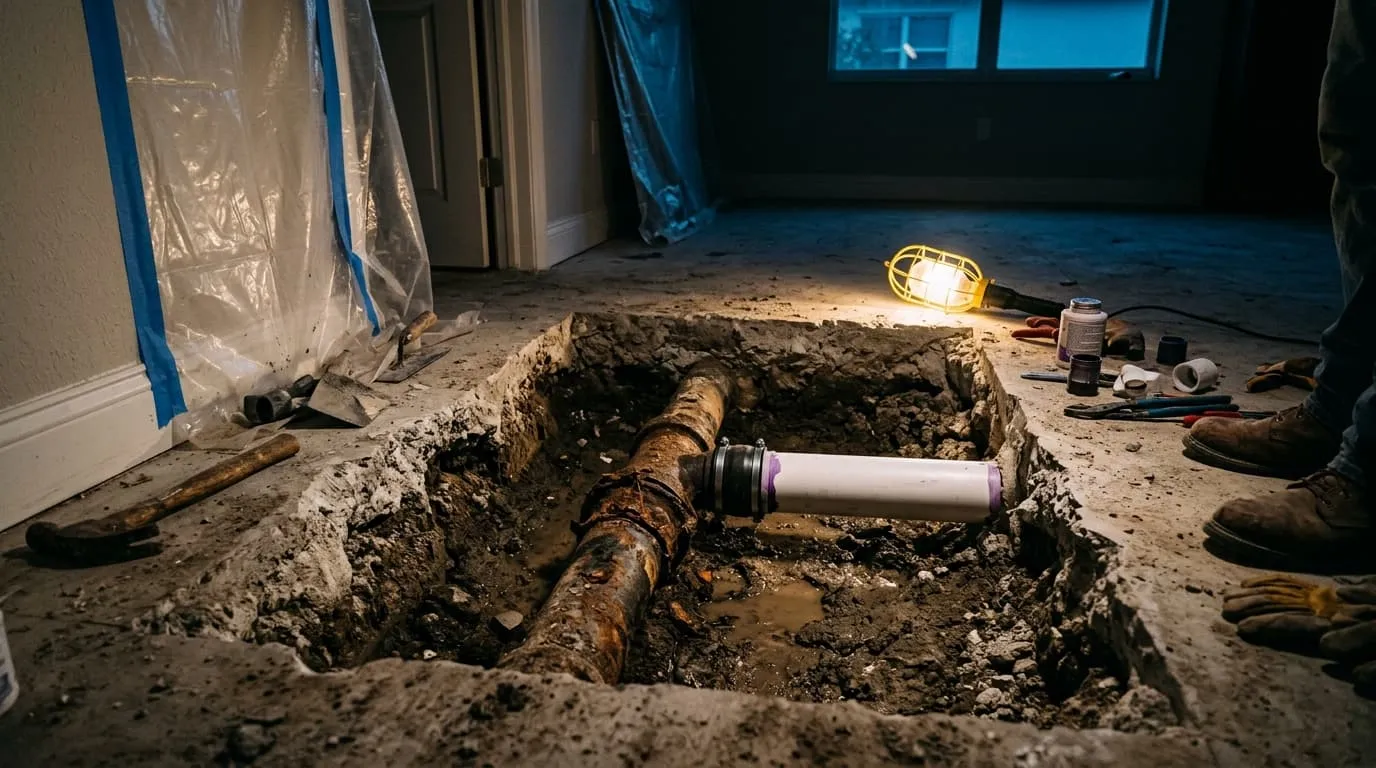
- Channeling. Corrosion favors the underside of the horizontal runs, where standing water and waste collect, and eats through there first. A channel, and eventually a hole, opens along the lowest part of the pipe.
- Escaping. Wastewater starts leaving the pipe directly into the soil beneath the slab. At this point there may be odor and a floor that feels soft or sounds hollow underfoot, and often no drainage complaint at all, because the water simply has somewhere else to go.
Why the final stage can look like good news
Once corrosion has opened a hole in the pipe’s underside, the backups that used to show up regularly can simply stop, because the waste now has somewhere else to go entirely, an outlet that did not exist before. A household whose recurring clogs suddenly vanished, with no repair having taken place, has not solved anything, and it is worth knowing that before mistaking it for good luck.
Finding out which stage applies to you
There is no real substitute for a camera. It is the only way to actually see the condition inside the bore instead of guessing at it from the symptoms. An inspection tells the difference between one weak section and a line that has thinned out evenly along its whole length, and those two findings lead to very different scopes of work. It also picks up the joints and transitions, which is frequently where cast iron gives out first.
The two ways forward
Traditional replacement means cutting the slab open along that run, then removing the old pipe, setting new pipe in its place, and restoring the slab, flooring and anything that sat above it. It is disruptive but final, and where a section has collapsed or shifted out of alignment, it is the only real option left.
Lining, known as cured-in-place pipe, instead pulls a resin-saturated liner through the existing pipe and cures it into a fresh pipe nested within the original. Manufacturers typically rate that liner’s design life at around 50 years, and it sidesteps most of the demolition. It does have a hard limit, though: there has to be a path for the liner to travel through. A section that has already collapsed, shifted badly at a joint, or is too clogged to clean out first cannot be lined. Trenchless repair cannot rebuild a pipe that has effectively stopped existing.
Age narrows the question; it doesn’t answer it
A house built before the mid-1970s that has never had its drain line replaced is very likely running on cast iron, and that pipe is either near or past its rated life. That is a reason to have a look, not a verdict on its own. Plenty of these lines are still holding up fine, some stretches fail while neighboring stretches don’t, and a camera is the only way to tell which is which.
A lookalike worth ruling out
Tree roots cause the same kind of repeat blockage, and they are common here since nothing in this climate goes fully dormant. The difference is what matters: a root has entered from outside, through a joint or a crack, and a plumber can cut it back. Corrosion, by contrast, is damage to the wall itself, with nothing to trim away. A single camera inspection tells them apart, and guessing wrong between the two usually means paying twice for a fix that was never going to work.
Questions
What people ask about cast iron drain lines
How can I tell if my house has cast iron drains?
Start with the age of the house: anything built roughly from 1945 to 1975 is likely to have it on the drain side unless someone has already replaced it. Where a section is exposed, in a garage or utility room, it looks heavy, dark and dull, and a magnet will stick to it. A camera run through the line confirms which material you have and shows its condition in the same pass.
The same drain keeps clogging in one spot. Is that the pipe’s fault?
When the same spot backs up again and again, that almost always means the pipe itself has roughened or partly caved in on the inside, rather than anything in particular going down that drain. Clearing it works for a while each time, but the gap between clogs tends to shrink, and that shrinking gap is the pattern worth mentioning to a plumber.
The backups just stopped happening. Isn’t that good news?
Not necessarily, and it deserves a look rather than an assumption. Once corrosion has opened a hole along the underside of the pipe, wastewater begins escaping straight into the surrounding soil, and the backups people used to notice can disappear even while the real damage keeps getting worse out of sight.
Can the pipe be lined instead of replaced?
Sometimes, depending on what a camera finds inside it. Lining works well on pipe that’s cracked, leaking or damaged by roots, as long as there’s still a clear path through it. It won’t work on a line that has collapsed or shifted badly out of alignment, since at that point there’s nothing left to run a liner through.
Does the whole line need replacing at once?
Not necessarily. Failure is often concentrated in specific runs, usually the older horizontal sections beneath the slab, and a camera inspection can tell a single bad stretch apart from a line that has aged out uniformly. What doesn’t make sense is repeatedly clearing a section everyone already knows is failing instead of dealing with it.
Would homeowners insurance cover this?
Cast iron failure is a recognized type of claim in Florida, but whether a given policy pays out depends on its wording and the cause, a question for the insurer, not a plumber. Either way, camera footage of the pipe’s condition is worth keeping on file.
Live dispatch · 24 / 7 / 365
Reading this because of an actual problem?
The phone is answered at any hour by a person who can walk you through the shut-off and get a plumber moving your way.
No obligation. Work performed under Florida plumbing contractor license CFC1433655.