
Five spots · one that can’t wait
A toilet is leaking: what to shut off first, and what the leak site tells you
A toilet can leak from five places, and only one of them means water is getting under the floor. Where it shows up tells you which repair you’re facing.
Stop the supply first, then pay attention to where the water is actually showing up. Four of the five places a toilet leaks from are routine fixture repairs; the fifth means water is already working its way under the floor.
What’s the first thing to do about a leaking toilet?
Find the small stop valve on the wall or floor beside the bowl, almost always on the left, and close it: an oval handle takes several turns, a lever only a quarter turn, and clockwise closes either type. Flush once to drain the tank; for most causes, the leak stops right there while you work out what happened.
If that valve refuses to budge, or turns but the water keeps flowing, go to the property’s main shut-off instead. A stop valve untouched for years often seizes, and forcing an old one risks snapping the stem, trading a drip for an open line.
With the water stopped, notice exactly where it is showing up next. A puddle collecting near the bowl’s base points to something else entirely than water appearing near the tank, and telling those two apart matters more than any amount of tightening.
Sorting the five
Five places a toilet leak starts, from harmless to urgent
Nearly every leaking toilet traces back to one of five causes, and a dry paper towel and a few minutes are usually enough to tell them apart. Which one you have changes everything about what happens next.
1. Tank to bowl, and nobody notices
This is both the most frequent leak in any house and the one that goes unseen the longest, because the water simply runs down the drain with the rest. A flapper that has stopped sealing, or a fill valve that never fully shuts, lets the tank bleed slowly into the bowl around the clock. A telltale sign is the fill valve switching on by itself every so often when no one has touched the toilet.
Confirming it takes twenty minutes: add a few drops of food coloring to the tank water, do not flush, and check the bowl later. Colored water in the bowl means the flapper is letting water through. It is an easy, inexpensive fix, and it is also one of the most common explanations for a water bill that climbs for no visible reason.
2. The supply line or the stop valve itself
A drip at the flexible hose feeding the tank, at the nut connecting it, or from the valve body, showing up as a small puddle off to the side or behind the toilet rather than out front. It is clean supply water, easy to spot, and the least concerning of the five, although a stop valve that has started corroding is worth swapping out rather than living with.
3. The seam between tank and bowl
If water runs down the outside of the bowl only right after a flush, suspect the gasket or the bolts joining the tank to the bowl. This is still a straightforward fixture repair with nothing reaching the floor beneath it, but it gets mistaken for a base leak often enough that the paper-towel test is worth doing properly: dry everything off, flush once, and watch exactly where the first drop shows up.
4. Sweating, which isn’t a leak at all
Worth calling out on its own, because this climate produces it constantly. A tank filled with cool water sitting in a humid bathroom will sweat, and the moisture dripping off it onto the floor can pass at a glance for a slow leak. If the puddle only shows up on muggy days, has nothing to do with when the toilet was last flushed, and the tank’s exterior is beaded with moisture, that’s condensation. It still deserves attention, since water sitting at the base will eventually reach the subfloor, but the fix is better airflow, not a wrench.
5. The base of the bowl: treat this one differently
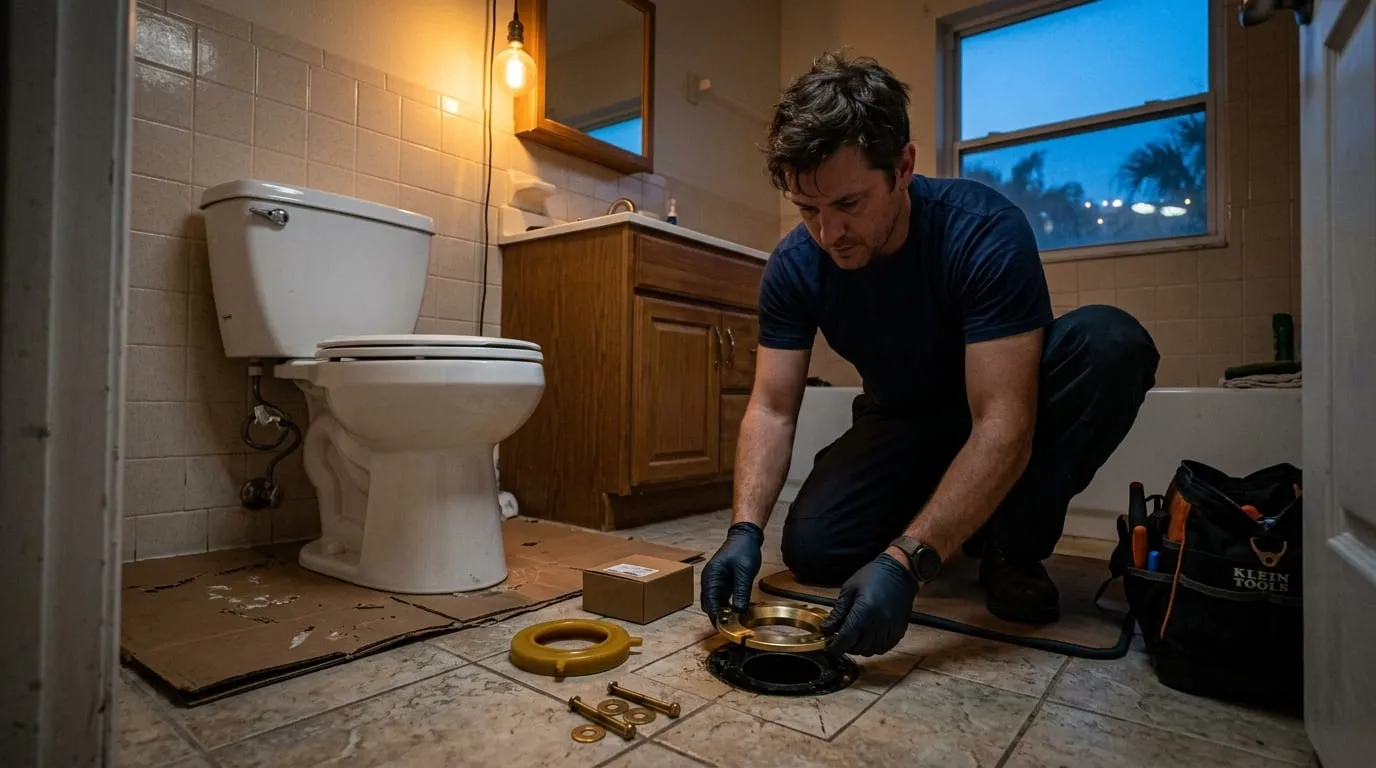
Water making its way out at the toilet’s base, especially right after a flush, points to a failed seal between the fixture and the drain beneath it. Unlike the other four causes, this isn’t clean supply water; it’s wastewater, and it’s headed under whatever flooring is there.
A toilet that rocks underfoot when someone sits is not a side note here. It is the likely cause. Whatever wore through the seal originally will just as easily wear through its replacement if the rocking continues unaddressed. Nearly every home in this region is built on a slab, and the closet flange a toilet secures to sits embedded in that concrete floor. A flange that has cracked or corroded turns this from a simple fixture swap into a floor-opening project, and letting it sit does not make it any better.
What tightening the base bolts can and cannot fix
A gentle snug of the two base bolts occasionally resolves a leak that just started. Cranking them down hard is a different story. It cracks the porcelain, and a cracked bowl means buying a new toilet instead of just a new seal. Go a quarter turn, check, and stop; do not lean into it. If light tightening doesn’t stop the water, the seal or the flange underneath has already failed, and no amount of extra torque brings it back.
Questions
What people ask about a leaking toilet
My toilet keeps running but I don’t see any water. Is that still a leak?
It is, and it’s often the most expensive kind precisely because nothing is visible: the tank is bleeding straight into the bowl and down the drain around the clock. The food-coloring test settles it in about twenty minutes without any tools.
There’s water at the base. Can I just wipe it up for now?
That is not a safe way to wait it out. Water at the base is wastewater heading under the flooring rather than sitting on top of it, and every flush sends more of it down there, quietly damaging the subfloor and whatever finishes are nearby.
The toilet rocks a little when I sit down. Does that actually matter?
More than the small movement suggests. Rocking is what breaks the seal against the drain, so a toilet that rocks either already leaks or is about to. It usually traces back to the flange, the mounting bolts, or a floor that isn’t quite level underneath.
What do I do if the stop valve won’t turn?
Stop trying to force it and use the property’s main shut-off instead, then have the stop valve replaced during the same visit. An old valve that hasn’t moved in ten years can shear off, and that turns a small, contained problem into a wide-open supply line.
Is a wet floor near the toilet always a sign of a leak?
Not always. In a humid bathroom, a tank full of cold water will sweat and drip, and it looks just like a slow leak. Wipe everything dry, then watch whether the water comes back with a flush, which points to the fixture, or with humid weather, which points to condensation.
Can I fix the base seal myself?
Plenty of people try. The catch is that lifting the toilet off is also the moment you discover whether the flange underneath is still sound, and on a slab foundation, a cracked flange set in concrete is a much bigger project than the one you started with.
Live dispatch · 24 / 7 / 365
Reading this because of an actual problem?
The phone is answered at any hour by a person who can walk you through the shut-off and get a plumber moving your way.
No obligation. Work performed under Florida plumbing contractor license CFC1433655.