
Eight signs · four worth acting on
Eight things people call a hidden leak, and which ones actually are
Four of these eight signs reliably point at a hidden leak. The other four mean nothing alone. In a slab house, the damp spot rarely marks where the pipe failed.
A slab won’t let water pool at the point of a failure. Instead it pushes sideways through whatever fill sits underneath, breaking the surface wherever it finally can. That is exactly why a damp patch marks an arrival point, not the source.
What actually points to a leak I can’t see?
Four signs are worth trusting: a water bill that jumped for no obvious reason, the sound of water moving somewhere in the house with every fixture off, a patch of flooring that feels warm underfoot, and a meter that keeps turning after everything inside has been shut down. Any one of those four is reason enough to look further.
Four more get treated as proof far more often than they deserve: a musty odor, a hairline crack in a wall or tile, an oddly green stretch of lawn, and weak water pressure. Each has ordinary explanations unrelated to plumbing, yet each can also show up alongside a genuine leak, which is exactly why none of them settles anything alone.
There is one test that actually proves it either way, costs nothing, and takes about twenty minutes: reading the meter. Everything else here is a reason to go run that test, not a verdict on its own.
One at a time
What each sign really tells you, and what it doesn’t
These are ranked by how much they actually prove, not by how often someone brings them up.
A water bill that climbed for no reason
This is the single most convincing sign, because a water meter has no opinions and no imagination. Check it against the same month a year ago rather than last month, since seasonal irrigation and visiting relatives shift usage on their own. A jump that holds steady across two or more billing cycles, with nothing in the household actually different, should be treated as a leak until something proves otherwise.
Water you can hear when nothing is running
Pick a quiet moment at night, close every fixture in the house, and listen carefully near the walls and along the floor. A soft, steady hiss or trickle means pressurized water is finding its way out somewhere. It’s a sign worth acting on; under a slab, though, the loudest point is often just wherever sound happens to carry best, not necessarily where the pipe actually gave way.
A floor that’s warm in one particular spot
About as close to proof as this list gets, though it only applies to hot-water lines. A section of tile or laminate that runs noticeably warmer than everything around it, with no sun hitting it and no appliance nearby to explain it, usually means a hot line is leaking somewhere beneath the slab. It’s also the sign people brush off most easily, since a warm floor doesn’t feel like an emergency the way a puddle does.
The meter still turning after the house is shut down
Of everything on this list, this is the only one that’s an actual measurement rather than a guess. Close every fixture, then either watch the low-flow indicator or take two readings twenty minutes apart; any change means water is leaving the system. A companion piece on this site walks through that test in full, including the follow-up that tells you whether the leak is inside the house or out in the buried yard line.
A musty smell
Not much on its own. This is a humid part of the country, and bathrooms, closets and air-handler cabinets carry a musty edge for reasons that have zero connection to a pipe. A smell that’s new, confined to one area, and shows up together with any of the four stronger signs deserves attention. Alone, it more often points to poor airflow or a condensate line from the air conditioner.
Cracking in tile, drywall or the slab
Often pinned on a leak, and sometimes actually caused by one, but the ground here simply shifts on its own: sandy fill settles, and the water table rises and falls with the wet season, pipe or no pipe. A crack that shows up abruptly and keeps spreading, particularly alongside flooring that has turned soft underfoot or a door that has begun sticking in its frame, is worth a look. A faint hairline crack that has sat unchanged for years is just an old crack.
An unusually green patch of lawn
A genuinely useful clue, but only rarely about the house itself. A single area of grass that is greener, thicker or wetter than the rest, especially somewhere between the meter and the building, points to the buried supply line. Just as often, though, it turns out to be a leaking irrigation head, which is an entirely different system and a far smaller repair. Check the irrigation before assuming the worst.
Weak water pressure
The least reliable sign of the eight. Pressure sags because of a valve that isn’t fully open, a clogged aerator, a pressure regulator on its way out, scale lining the inside of old galvanized pipe, or utility work happening out at the street. A leak large enough to drag down pressure across the whole house has usually already made itself known some other way.
Why the wet spot usually isn’t the leak
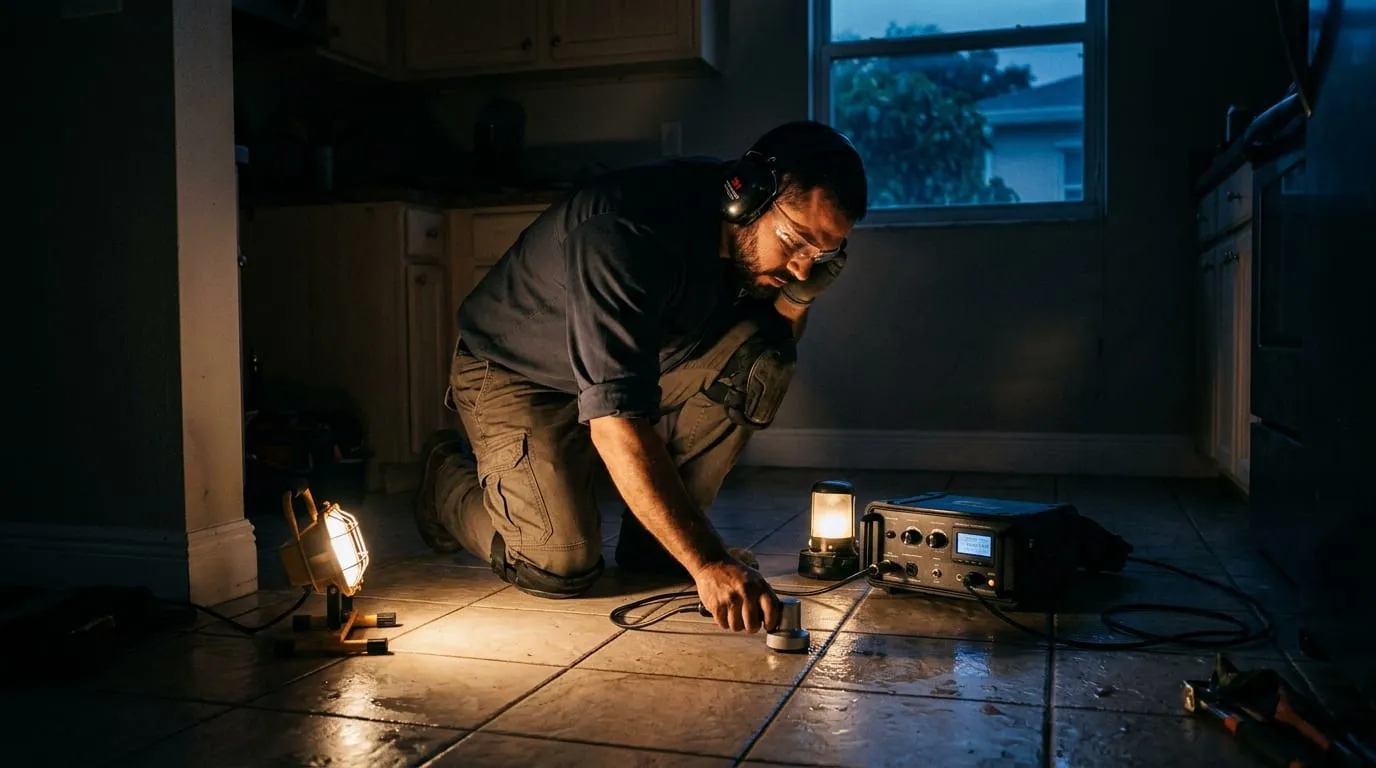
Here is the local wrinkle that generic advice never accounts for. Almost every home in this region sits directly on a slab, with the water table sitting not far beneath it. Pressurized water escaping under that concrete doesn’t collect at the point of failure. It spreads sideways through the compacted fill beneath until it reaches some kind of opening, whether a seam, a hairline crack, an expansion joint, or simply the lowest point the floor offers, and that is where it finally shows itself. The damp spot on the baseboard confirms water arrived there; it says almost nothing about where the pipe actually gave way. That is the whole case for locating a leak with acoustic and thermal tools before anyone starts opening the floor.
Questions
What people ask about hidden leaks
How do I tell a slab leak apart from a roof leak or an AC condensate leak?
Pay attention to timing and temperature. Water that shows up whenever it rains points to the roof or the building envelope, while water pooling near an air handler, or following its drain line, points to AC condensate instead. A steady leak that keeps going no matter the weather, and that still registers on the meter once the house is shut off, is coming from the supply line.
Would a hidden leak show up on the bill before I notice anything else?
Often, yes, which is exactly why the bill is such a strong early warning. A leak under a slab can run for months before enough water works its way to the surface to be noticed, while the meter has been quietly recording every gallon of it the entire time.
One spot on my floor feels warm. Does that mean I definitely have a leak?
It’s one of the more trustworthy signs, though it only applies to hot-water lines, and something else generating heat nearby could theoretically cause it too. Running the meter test with everything switched off is what turns that suspicion into a confirmed fact.
Will my homeowners insurance pay for this?
That depends on the policy and the cause, and it’s really a question for the insurance company rather than a plumber. What’s worth knowing going in is that most policies separate the water damage itself from the cost of repairing the pipe, so it helps to note the date you first noticed the problem.
How long is it safe to leave a hidden leak alone?
Not long. Water running under a slab doesn’t stay in one place. It undermines the fill, soaks the subfloor, and works its way into cabinetry and finishes, and none of that damage tracks with how small the original leak was. Caught early, it’s a repair. Left alone, it turns into a restoration project.
Live dispatch · 24 / 7 / 365
Reading this because of an actual problem?
The phone is answered at any hour by a person who can walk you through the shut-off and get a plumber moving your way.
No obligation. Work performed under Florida plumbing contractor license CFC1433655.